
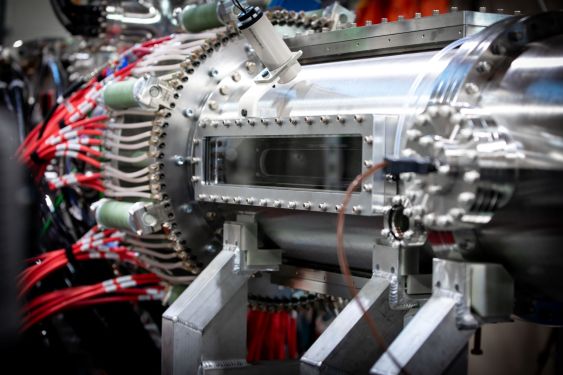
Zap Energy unveiled its newest fusion device at a research meeting in Long Beach, California. This device, named Fuze-3, is the latest in a series built by the company as it works to commercialize fusion power. The startup is competing with several others that aim to build fusion power plants capable of supplying electricity to the grid in the early 2030s.
The Fuze-3 device has been operating at the company’s Seattle headquarters, where it fires pulses of plasma. The data from these experiments will guide the design of Zap Energy’s future demonstration plants. In tests, the device compressed a soup of charged particles, known as plasma, to over 232,000 psi and heated it to more than 21 million degrees Fahrenheit.
This pressure achievement sets a record for the specific type of fusion Zap is developing, called a sheared-flow-stabilized Z-pinch. The reactor uses electrodes to send electricity through a plasma, generating a magnetic field. If this magnetic field is sufficiently powerful, it heats and compresses the plasma to the point where the particles within it fuse.
These results are a significant step for Zap Energy as it works toward commercial fusion power. However, it is important to note that these figures are not directly comparable to results from other fusion startups, as they use different technological approaches.
Achieving high-pressure plasmas is essential for any future fusion power plant. For a fusion reaction to generate more power than it consumes, it must achieve a high “triple product,” which describes the plasma’s temperature, pressure, and how long it is sustained.
According to Zap Energy’s own calculations, the company must increase its plasma pressure by at least ten times to reach scientific breakeven, a milestone very few experiments have achieved. The company stated it is nearing a key third milestone proposed by a competitor’s CEO.
Zap broke the plasma pressure record by modifying its reactor design to include a third electrode. Earlier designs with two electrodes could heat the plasma but could not achieve the desired pressure levels. The company did not disclose specific details about the new design but confirmed it allows for the use of two power banks, providing greater control over the plasma’s behavior inside the reactor. A spokesperson noted that while the plasma chamber looks similar, the operation is very different due to the two pulses of input power.
Zap Energy is already developing a new generation of its Fuze device, which is expected to become operational this winter.