
World Labs, founded by Fei-Fei Li, has secured a $200 million investment from the software design giant Autodesk. This partnership will see the two companies collaborating to explore how their technologies can work together. They will investigate integrating World Labs’ AI models, which generate and reason about immersive 3D environments, with Autodesk’s industry-standard tools, and vice versa. The initial focus for this collaboration will be on entertainment use cases.
Autodesk confirmed this deal is part of a larger funding round for World Labs, though further details were not disclosed. World Labs emerged from stealth in 2024 with $230 million in funding at a $1 billion valuation. Reports now indicate the startup is in talks to raise capital at a staggering $5 billion valuation. For World Labs, Autodesk’s investment serves as a strong signal of the commercial appeal of its product.
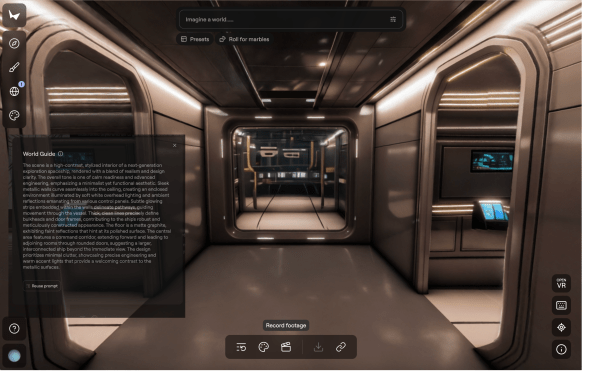
The startup’s first commercial product, named Marble, was released last November. It allows users to create editable and downloadable 3D environments. Autodesk, as one of the world’s largest developers of 3D computer-aided design software, provides the foundational platform for architectural, engineering, construction, manufacturing, and entertainment workflows. This focus on the built world makes an investment in advanced spatial AI a natural extension of its core business.
As Fei-Fei Li stated, Autodesk has long helped people think spatially and solve real-world problems. Together, the companies share a purpose of building physical AI that augments human creativity and puts more powerful tools in the hands of designers, builders, and creators. As part of the deal, Autodesk will serve as an advisor to World Labs, and the two will collaborate at the research and model level.
Daron Green, Autodesk’s chief scientist, explained that the partnership is still in its early days, so the precise form it will take is not yet determined. He suggested that customers might start with a world-model-based sketch created in World Labs, such as an office layout, and then use Autodesk’s technology to drill down into specific design aspects like a desk. Conversely, a user might take an object designed in Autodesk’s platform and place it into a context generated by World Labs. Green clarified that data sharing is not part of the current agreement.
The two companies plan to begin with media and entertainment applications. This aligns with the strategy of most companies building world models, including Google DeepMind and Runway, which see gaming and interactive entertainment as a primary initial market. Autodesk already works with most major media production companies and has been training models for character animation. Green noted these animation models are close to world models, as they characterize an animal responding to physical constraints, and could be combined with World Labs’ technology to create interactive worlds.
This partnership supports Autodesk’s broader initiative to integrate more AI across its software portfolio. The company is developing “neural CAD,” a new kind of generative AI model trained on geometric data. This model can reason about components and entire systems, generating functional 3D designs with an understanding of real-world physics. Autodesk’s neural CAD models are already being integrated into its product design and architecture software. World Labs’ models could help extend this capability beyond individual files toward more holistic digital representations of the physical world.
Green believes different AI systems, including large language models, world models, and neural CAD, will eventually be combined to deliver better designs for customers. As Fei-Fei Li emphasized, for AI to be truly useful, it must understand worlds, not just words. Worlds are governed by geometry, physics, and dynamics, and reconciling the semantic, spatial, and physical is the next great frontier of AI.