
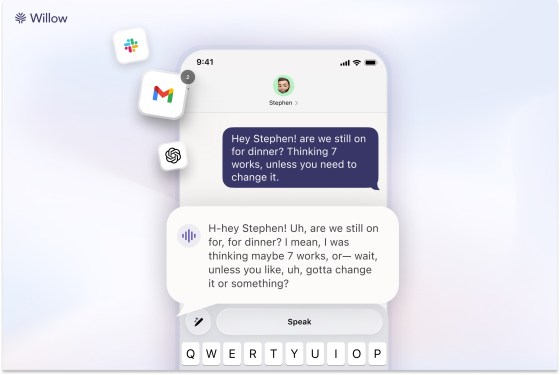
One of the most effective use cases from modern AI models is their improved ability to understand the human voice, leading to more accurate dictation tools. A Mac tool named Willow is launching an iOS app that allows users to type with their voice across all applications.
Similar to Wispr Flow, Willow’s keyboard transcribes your voice and formats the message according to the context. The app supports over one hundred languages and lets you define your own vocabulary terms or create different writing styles for various app categories like work, messaging, and email.
A key advantage of Willow’s app is the availability of a full keyboard for typing, whereas Wispr Flow only offers a numeric keyboard. This facilitates quick edits to modify words or sentences without needing to type them out entirely. You also do not have to switch to another keyboard when you prefer to type some words instead of speaking them.
Willow was founded by Allan Guo and Lawrence Liu, who attended Stanford and left to build a startup. Guo was accepted into Y Combinator in the summer of 2024 with a different set of co-founders, and their initial idea was in healthcare, specifically software to manage assisted living facilities. However, that idea did not succeed, and for a year the company tried to build different products.
While working on healthcare solutions, the founders noticed that doctors use voice AI scribes to record conversations with patients and create follow-up documents. After many conversations with doctors who found these notetakers very useful, they were nudged to build a voice AI tool for knowledge workers and other users.
Guo added that he chose not to build another AI notetaker because he felt that market was saturated. Instead, the dictation space was more appealing as a lot of communication occurs outside of meetings. The company uses a series of models and focuses heavily on tuning its text-to-text pipeline, which is based on Meta’s Llama models, for formatting and personalization.
The startup then moved its Y Combinator batch to Spring 2025 to launch the product. The company said it has grown fifty percent month over month in terms of users since its launch. It also has enterprise customers like Uber, Heidi Health, and Zegna using the tool for dictation with features such as custom team vocabulary.
Willow has raised four and a half million dollars from Box Group, Y Combinator, Burst Capital, and angel investors such as HubSpot’s Dharmesh Shah, Gusto’s Tomer London, Reddit co-founder Alexis Ohanian, ex-Yelp COO Kipp Bodnar, Opendoor CEO Kaz Nejatian, Adam Guild, and Instacart co-founder Max Mullen.
Mullen said he believes the most amazing user interfaces in the future will be voice-led. He was impressed with Allan’s vision to not just create a great dictation app but to aim long term for creating an interface that can control your computer. He noted that when writing through Willow, he needs to make fewer edits than with a computer’s built-in dictation system.
Mullen pointed out that one of his favorite workflows on desktop is using the Hey Willow assistant to instruct the app to write things like email replies in your own voice.
The startup competes with other players like Wispr Flow, which has raised more than fifty-six million dollars in funding, Monologue, which is part of a subscription bundle, and several Y Combinator-backed startups including Aqua, Talktastic, Superwhisper, and Betterdication.
Guo said that in the coming months, the company plans a platform expansion with Windows and Android, along with better personalization to reduce the number of manual edits users have to make after dictation.