
Nalden, who co-founded the file transfer service WeTransfer in 2009 along with Rinke Visser and Bas Beerens, is not pleased with the company’s direction after it was acquired by Bending Spoon last year. He does not mince his words about it.
He stated that Bending Spoons does not really care about people, and while he understands their private equity strategy, he believes that since he left WeTransfer in 2019, many updates have essentially been killing the product from his point of view.
Following the acquisition, WeTransfer made confusing changes to transfer link experiences and laid off 75% of its staff. This year, the company was caught in a controversy for using its users’ content to train AI models and had to backtrack on changes to its terms.
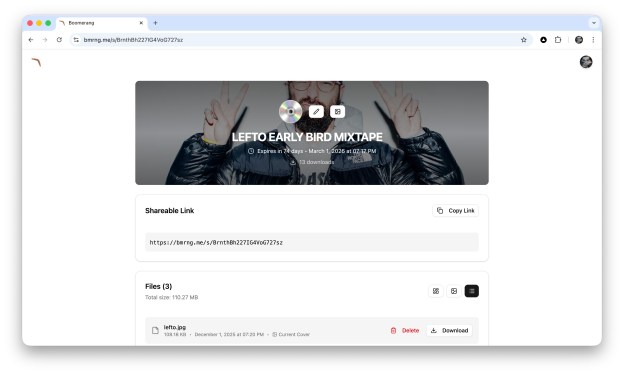
Around this time, Nalden heard from creatives sharing their frustration with WeTransfer. This led him to realize he wanted to build an alternative that recaptured the original ethos of simplicity. That service is called Boomerang, and it allows users to transfer files without logging in.
Nalden explained the ethos of Boomerang by asking why tech companies always make things so complicated. He wanted to offer a tool that is all about user experience, ease of use, and the simplicity of sharing something quickly to save time. There is no need to sign up or verify via email.
For casual users, the non-login experience is sufficient but has its limits. It offers 1GB of total space, allows uploads of up to 1GB per file, and files expire after seven days. Users can choose to create a free account for more features, which provides 3GB of total space, a 3GB per file upload limit, access to upload history, the ability to add and delete files anytime, and the option to customize emojis on the file transfer page.
There is also a paid tier for 6.99 euros per month. This provides 200GB per space, 500GB of total storage, a 5GB per file upload limit, custom covers for spaces, password protection for files, up to 90 days of expiry, and the ability to invite unlimited users to access files in a space.
Nalden is clear that with Boomerang he does not want to offer advertising to users and prefers to keep a simple payment structure. He feels the advertising business adds a lot of complexity, and with Boomerang he aims to collect the least amount of data possible from users.
He compared it to buying a hammer; you do not necessarily want a fancy hammer, but one that just works. Boomerang’s site and interface are deliberately barebones. Nalden noted that a lot of design is to please investors, and he feels stripping down the experience is a refreshing change.
While many companies are looking to add more AI features, Nalden said he is largely using AI to build the product internally but does not want to use it for user-facing features. Boomerang is currently available on the web, with plans to release a dedicated Mac app soon.