
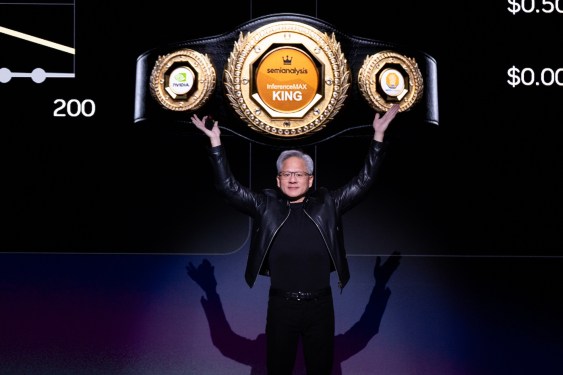
When Nvidia CEO Jensen Huang took the stage for his annual GTC keynote on Monday, the $4 trillion company’s stock started to drop. Wall Street investors were unmoved by the leather jacket-clad founder’s bullish two-and-a-half-hour speech. Instead, they placed more weight on AI’s uncertain future and fears of a bubble. This nervousness on Wall Street stood in stark contrast to the buzzy atmosphere in Silicon Valley, where confidence, not uncertainty, abounds.
Huang talked for more than two hours about the company’s latest innovations. These ranged from new video game graphics technology and updated networking infrastructure to autonomous vehicle deals and a new chip designed with Groq to accelerate AI inference in the Vera Rubin system. He also shared some eye-watering numbers about Nvidia’s business and beyond. Huang called the AI agent ecosystem a $35 trillion market and the physical AI and robotics industry a $50 trillion market. He also said he expects to see $1 trillion worth of purchase orders for the company’s Blackwell and Vera Rubin chips by the end of 2027.
Shouldn’t that make investors excited? According to Futurum CEO Daniel Neuman, it is not surprising that it does not. He explained that AI is so transformational and moving so fast that we do not understand what it will mean for our societal constructs. Markets hate uncertainty, and the speed of innovation has created a great new uncertainty that most people never expected.
Neuman added that some uncertainty comes from misleading market information. He said headlines about low enterprise adoption of AI are not painting the full picture, based on his conversations. He believes enterprise AI adoption is going to hit an inflection point and scale very quickly. The delay in visible return on investment is because it takes months to aggregate data, not because adoption is not happening.
This sentiment holds weight when examining Nvidia’s past quarterly numbers. While companies may not be touting their AI ROI, they are increasingly purchasing Nvidia’s technology. The company continues to not only beat its lofty goals and quarterly estimates, but soar past them. Nvidia’s revenue was up 73% year-over-year last quarter.
There is no sign that will change anytime soon. For example, just this week Nvidia confirmed Amazon made a plan to purchase 1 million GPUs, alongside other AI infrastructure, by the end of 2027 for Amazon Web Services.
Kevin Cook, a senior equity strategist at Zacks Investment Research, agreed with Neuman. He joked that investors not being happy does not change the fact that the whole stock market is propped up by Nvidia, because its tech runs the rails for many businesses. He stated that the economy is sort of orbiting around Nvidia as it builds necessary infrastructure for companies in hardware, software, and physical AI.
None of this means there is not currently an AI bubble or could not be one in the future. But while GTC may not have been a boon for Nvidia’s stock, the broader uncertainty does not seem to be Nvidia’s problem. The company is clearly barreling full steam ahead, bringing seemingly the entire global economy right alongside it. As Huang said in his keynote, Nvidia is a platform company with its technology, platforms, and a rich ecosystem at the center of industry.