
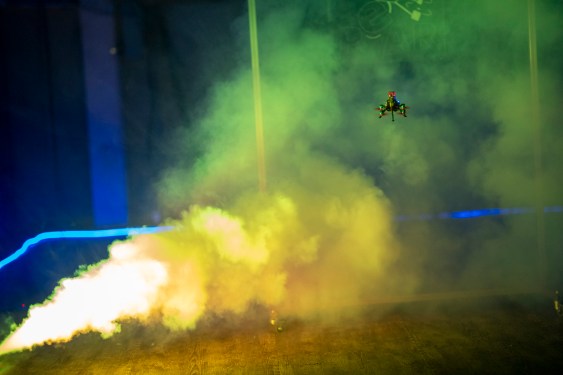
Search and rescue missions often occur in areas that are difficult for humans to navigate. These environments can feature extreme weather, rough terrain, or dangerous conditions like heavy smoke or dust. A researcher at Worcester Polytechnic Institute, or WPI, proposes sending robots inspired by bats on these missions instead of people.
Nitin J. Sanket, a professor at WPI, has developed small flying robots with his team. These robots fit in the palm of a hand and use ultrasound for navigation, just like bats. The devices employ AI-powered software to filter out noise from the ultrasound signals they collect. This allows them to detect obstacles within a two-meter radius.
Sanket explained that search and rescue is typically done on foot. He noted that many people go out with flashlights in harsh conditions, putting their own lives in danger to save others. He believes drones are the answer because they can cover a lot of ground quickly while being agile and swift.
Sanket has long been fascinated by aerial robots and drones and how the technology can be adapted for real-world situations. During his PhD program, his advisor challenged him to create the smallest robot possible. This challenge sparked his research into taking cues from biology to build smaller machines.
He stated that they had to reimagine what a drone could be, which meant looking to biology because it performs these tasks much better than current technology. He questioned how insects or birds achieve flight with limited computing power and less advanced senses. Their eyes are not that powerful and their brains are small, yet they accomplish amazing feats of flight. This line of inquiry gave rise to his PhD thesis.
Sanket built a prototype of a robotic beehive made of small drones designed to pollinate flowers. Despite his efforts, he realized this application was likely a long shot. He then began considering areas where biology-based robots could make a difference sooner, which led him to his current project.
For the search and rescue robots, the main challenge was building something with the necessary sensors and flying technology without making the robot too large, expensive, or energy intensive. The team turned to the ultrasound sensors commonly found in automatic faucets because they require very little power. While this approach worked, the propellers on the robots created excessive noise, which overwhelmed the sensor’s ability to detect obstacles.
To fix this problem, they looked to bats for inspiration. Sanket explained that bats have special tissues in their nose, ears, and mouth that adaptively change in thickness and density. This modulates the way they hear and produce sound. The team designed a 3D-printed structure to place in front of the robot. This structure functionally mimics what a bat does by changing the shape of the sound itself.
Now that the robots are operational, the team is working to tackle their next challenge, which is improving their speed. Sanket reflected that human beings often try to mimic the human brain, but they tend to forget how remarkable other animals are. He noted that insects and birds, which are much smaller, can perform remarkable feats of navigation. He believes that as scientists, rather than just pure engineers, we should think more about these capabilities.