
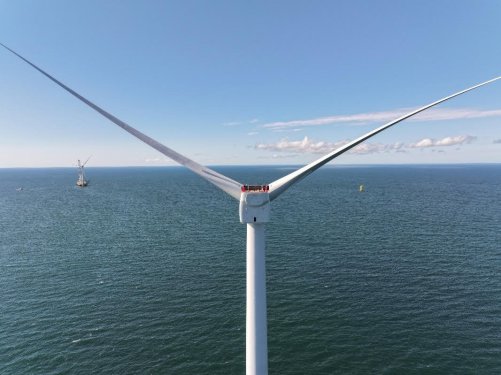
The power crunch for AI data centers has become so severe that people are now talking about launching servers into space to access solar power around the clock. One startup, however, believes the ocean is a better place for them. Offshore wind developer Aikido is planning to submerge a 100-kilowatt demonstration data center off the coast of Norway this year. The small unit will live in the submerged pods of a floating offshore wind turbine. If all goes well, the company hopes to build a larger version to deploy off the coast of the UK in 2028. That model will feature a 15 to 18 megawatt turbine that will feed a 10 to 12 megawatt data center.
Moving offshore could solve several challenges. Proximity to power is an obvious one, since the energy source sits directly overhead. Winds offshore are more consistent than onshore, and a modest battery could bridge any lulls. Submerged data centers could also eliminate concerns from NIMBY groups—”not in my backyard”—who oppose data centers near their properties over noise and pollution concerns. Lastly, by floating in cold seawater, cooling the servers becomes a simpler proposition. Cooling is one particularly vexing issue for orbital data centers, since they must employ different techniques in the vacuum of space.
But for all the challenges offshore data centers solve, they introduce a few more. The ocean is a harsh environment. While submerged servers would not be battered by waves, they also would not be completely stationary, so they would need to be fully secured. Seawater is also corrosive, so any equipment, including the container and power and data connections, will need to be hardened against it.
Aikido is not the first company to propose sinking data centers in seawater. Microsoft first floated the idea over a decade ago, and in 2018 it launched an experiment off the coast of Scotland, which was modestly successful. Only six of more than 850 servers failed in the 25-month trial. The data hall was filled with inert nitrogen gas, which might help explain the servers’ low failure rates. Microsoft accrued a number of patents over the years, which it open-sourced in 2021. But by 2024, the company had deep-sixed the project.