
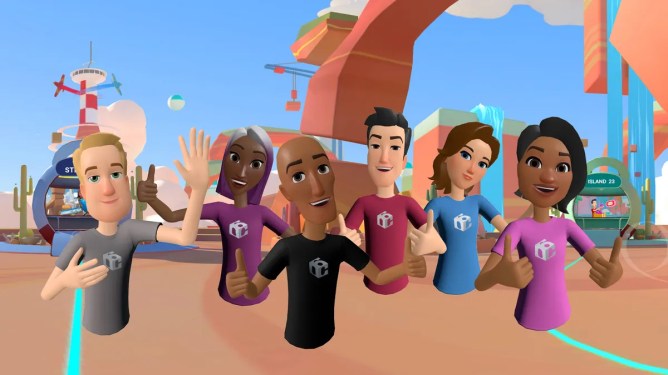
Meta’s enormous bet on virtual reality has come to a definitive end this week. The company reportedly laid off roughly 1,500 employees from its Reality Labs division, about 10% of the unit’s staff, and shut down several VR game studios. This marks a huge reversal for a company that, just four years ago, staked its entire identity on the concept.
Few are going to miss it. As industry watchers might remember, Facebook rebranded itself as Meta in 2021, promising to usher in a new era of technology led by VR devices. The decision was partly a bet on Gen Z’s preference to socialize in online games like Fortnite and Roblox over traditional social media apps. The change also helped Meta distance itself from the negativity surrounding its Facebook brand, which had been damaged by data privacy scandals, whistleblower reports, Congressional hearings, and more.
Meta’s vision was that the metaverse would be the next big social platform, where users connected in a virtual world via its Horizon Worlds app. Fast-forward to today, and the metaverse has effectively been abandoned in favor of AI.
The casualties of this shift include studios making VR titles inside Meta, such as Armature Studio, Twisted Pixel, and Sanzaru. The VR fitness app Supernatural, which Meta acquired for $400 million, will no longer produce new content and will move into maintenance mode. Camouflaj, the studio behind the Batman Arkham Shadow VR game, has also been impacted by layoffs. Meta’s program to bring VR to work, Workrooms, is shutting down as well.
This news follows an earlier report from December that Meta was slashing the virtual reality department’s budget by up to 30%. Around the same time, Meta announced it was pausing its program to share its Meta Horizon operating system with third-party headset makers.
Unlike the news of Meta’s rebrand, the deprioritization of the metaverse should come as no surprise. The division lost money at an excessive rate, worrying investors, and had never turned a profit. In total, the company funneled some $73 billion into Reality Labs. To put that into context, you would have to spend $1 million per day for 200 years to match that spending.
Beyond being overhyped by investors and analysts, initial versions of the metaverse were simply bad products. The goofy, soulless avatars did not even have legs, and one metaverse selfie of CEO Mark Zuckerberg became a viral meme. Meta was overpromising a future while its product still under-delivered. It was a failure of the build in the open model, where early tech products are shipped to consumers for feedback. That model works when customers are actively interested, but for the metaverse, there was only middling consumer demand.
Though Meta quickly gained a majority share of the VR market with its Oculus headsets, sales declined. Global VR headset shipments fell by 12% year-over-year in 2024, their third consecutive year of declines. Meta accounted for 77% of those shipments.
Meta was betting on an app store model before VR reached scale, more interested in the profits from running its own platform than whether consumers wanted these face computers. Zuckerberg was looking for a way to bypass Apple and Google’s app store fees. He proposed the metaverse could grow to a billion people, hosting hundreds of billions in digital commerce, with analysts backing up forecasts of a multi-trillion-dollar platform by 2030.
However, the apps built for the metaverse were not being adopted in massive numbers for a company of Meta’s size. Estimates show the Meta Horizon app has been downloaded tens of millions of times, but its user activity, while growing, likely was not enough. For comparison, Meta now has over 3.5 billion daily active users across its social apps Facebook, Instagram, WhatsApp, and Messenger.
Had this succeeded, Meta would have created a new social empire built on VR gaming. But Zuckerberg telegraphed his desire to tap into developer revenue far too soon. Meta announced plans to take a whopping 47.5% of the sales of digital assets within Horizon Worlds, a move that unsurprisingly did not make creators happy.
Compounding these issues, Meta was not building the metaverse with user safety as a top priority. The company tended to be reactive, such as only rolling out a Personal Boundary feature after reports of sexual harassment and even virtual assaults in Horizon Worlds. Detailed policies and consequences for abuse were lacking, and support tools often felt insufficient to users who experienced harm.
Another nail in the coffin was the success of Meta’s Ray-Ban smart glasses, which saw increased consumer interest. With features for recording, music, and AI, they began to outsell traditional Ray-Bans in some stores. With an eye on AI, the company is now considering doubling output to meet demand. Other companies are also looking to AI hardware devices as the next potential computing platform, making VR seem like a dated relic.
Combined, these factors make it hard for Meta to continue justifying its spending on VR. Instead, Meta will focus on products with more potential, like its Ray-Ban smart glasses, the growth of its AI apps, and its large language models.