
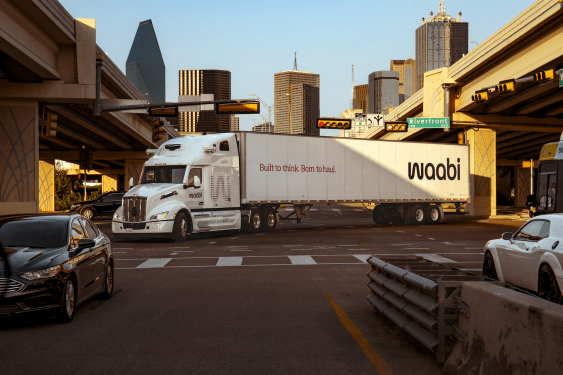
Autonomous vehicle startup Waabi has raised one billion dollars and formed a partnership with Uber to deploy self-driving cars on the ride-hailing platform. This marks the company’s first expansion beyond its original focus on autonomous trucking.
The funding includes an oversubscribed seven hundred fifty million dollar Series C round co-led by Khosla Ventures and G2 Venture Partners. It also includes roughly two hundred fifty million dollars in milestone-based capital from Uber to support the deployment of twenty-five thousand or more Waabi Driver-powered robotaxis exclusively on its platform. The companies did not provide a timeline for this large-scale deployment.
The partnership represents a bet that Waabi’s AI technology can succeed where others have struggled, specifically in scaling across multiple self-driving applications with a single technology stack. While competitors like Waymo previously attempted both robotaxis and trucking before shutting down its freight program, Waabi founder and CEO Raquel Urtasun says her company’s capital-efficient approach and generalizable AI architecture give it a unique advantage to tackle both markets simultaneously.
Urtasun stated that their core technology enables a single solution that can operate multiple verticals at scale. The collaboration brings Urtasun’s work full circle, as she previously served as chief scientist at Uber’s autonomous vehicle division, which Uber sold to Aurora Innovation in 2020. It also builds on Waabi’s existing partnership with Uber Freight.
Waabi is one of several autonomous vehicle companies that Uber has partnered with to deploy self-driving vehicles globally. Other companies include Waymo, Nuro, Avride, Wayve, WeRide, Momenta, and more. This new partnership and funding coincide with Uber launching a new division called Uber AV Labs, which will use its vehicles to collect data for its autonomous vehicle partners.
According to Urtasun, Waabi is not as reliant on massive amounts of real-world data as some competitors. The Waabi Driver is trained, tested, and validated using a closed-loop simulator called Waabi World. This system automatically builds digital twins of the world, performs real-time sensor simulation, manufactures scenarios to stress-test the driver, and teaches it to learn from mistakes without human intervention. Urtasun says this allows the Driver to reason about its surroundings like a human and learn from fewer examples than traditional systems.
Waabi has spent over four years developing this technology for trucks on highways and surface streets. Urtasun says the underlying AI, called the Waabi Brain, already generalizes to different vehicle form factors, and the company has hinted at a future expansion into robotics. From the beginning, Waabi collected passenger car data alongside its trucking work, indicating robotaxis were always part of the long-term plan.
Urtasun claims this approach has allowed Waabi to build faster and cheaper than competitors, requiring fewer human developers, large fleets, massive data centers, and energy consumption. This deal brings Waabi’s total funding to approximately one point two eight billion dollars. Competitors Aurora Innovation and Kodiak Robotics have raised three point four six billion dollars and four hundred forty-eight million dollars, respectively.
In five years, Waabi has launched several commercial pilots with a safety driver in Texas. The company had planned to launch a fully driverless truck on public highways by the end of last year, but that rollout has been delayed until sometime in the next few quarters. Waabi is working with Volvo to build purpose-built autonomous trucks, which were revealed last October. Urtasun says the Waabi Driver software is ready, but the trucks themselves require full validation before launch.
Urtasun is confident in demand for Waabi’s trucks due to a direct-to-consumer model that lets shippers buy outfitted trucks directly. She is also confident that the Uber partnership will allow Waabi to quickly penetrate the robotaxi market and scale with a reliable product. She stated that the industry is still in the early stages of robotaxi deployment and that there is much more scale to come.
Urtasun did not share specifics about the Uber rollout, such as which automaker Waabi would partner with for the robotaxis. She did say Waabi would take a similar approach to its trucking program by integrating its sensors and technology into the vehicle from the factory floor with an original equipment manufacturer, believing this vertical integration is key to building safe and scalable technology.
Other investors in Waabi’s Series C round include Uber, NVentures, Volvo Group Venture Capital, Porsche Automobil Holding SE, BlackRock, BDC Capital’s Thrive Venture Fund, and others.