
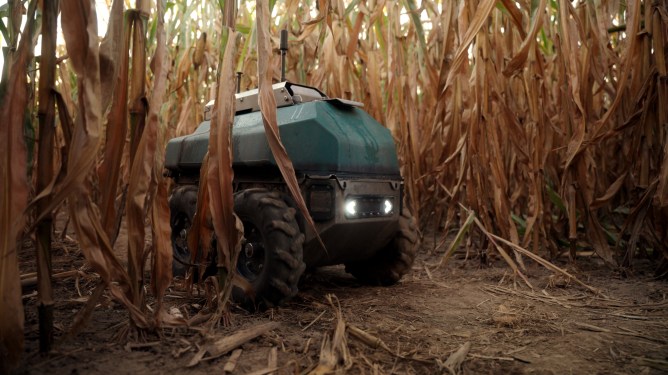
The founders of Upside Robotics met in 2023. They were both looking to build an impact-driven company focused on climate and agriculture. Less than a year later, they were sleeping in a camper on the side of a Canadian corn field while building their robotics startup.
Based in Waterloo, Ontario, Upside Robotics builds lightweight, solar-powered autonomous robots. These robots deliver right-sized amounts of fertilizer and nutrients to crops exactly when they are needed. The company’s software runs on proprietary algorithms that use weather and soil data to decipher when and how much fertilizer the plants require.
Upside’s robots currently work on corn plants, one of the most fertilizer-intensive crops. The company chose corn for that exact reason, according to co-founder and CEO Jana Tian.
After Tian and Sam Dugan, co-founder and chief technology officer, met at the Entrepreneur First accelerator, they decided to focus on reducing fertilizer waste using robots. This focus fit squarely into the center of their shared interests and leaned well on their backgrounds. Dugan had been building robots since he was ten years old, and Tian had years of experience as a chemical engineer in the food division at Unilever.
Customer discovery with farmers further confirmed this was an area where farmers were willing to pay for a better solution.
Traditionally, the way fertilizer has been applied means only 30% of it gets taken up by the crop, so a majority is wasted. Farmers usually do one application per season, so they have to front-load a lot of the fertilizer. But crops need fertilizer during the season as well. The founders knew it was a problem that many growers really wanted different solutions for.
The pair formally founded Upside Robotics in 2024 and then hit the fields literally. They bought a camper trailer and moved from field to field, staying on the side of a field every night. They would be walking, sometimes around the clock, and have spent every hour of the day in a corn field at some point in time.
Dugan built a robot in two weeks so they could start testing their idea. This device was a remote-controlled car that they would operate manually. They followed the robot around the fields to collect data and demonstrate how the fertilizing system would work to farmers.
They did their manual applications in year one, which allowed them to iterate super fast, not just on the hardware side, but by learning from being with the farmers. Some farmers said the founders spent probably more time than they did in a lifetime in their fields. That allowed the team to learn quickly. Neither founder was a farmer, so that gave them firsthand experience into what it is like to basically be one.
After spending the 2024 season proving the company’s concept, they spent that off-season developing the fourth generation of their robot for the 2025 growing season. They went from 70 acres in 2024 to 1,200 acres in 2025.
Now, the company is gearing up to serve more than 3,000 acres in the upcoming 2026 season with 100% customer retention since the beginning. Upside reported that it has thus far helped its customers cut fertilizer use by 70%, which equates to around $150 in savings per acre per season.
Upside recently raised a $7.5 million seed round led by Plural with participation from Garage Capital and the founders of Clearpath Robotics.
The funding will be used to continue funding research and development and to keep up with demand, as there are more than 200 farms on their waitlist. The company also hopes to expand out of Canada with a target of breaking into the U.S. corn belt.
People always question if farmers are going to adopt new solutions, and they certainly are. That’s something the founders learned firsthand, as long as you can provide a clear return on investment and a clear reason why the technology was built. In their case, it wasn’t something they actually had to sell to farmers. In a lot of cases, their farmers actually asked for this solution.