
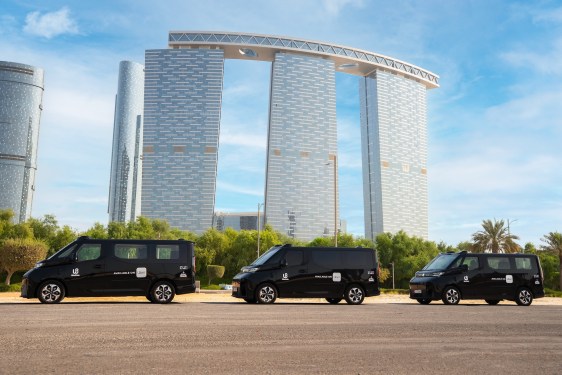
One year after launching a commercial robotaxi service in Abu Dhabi, the Chinese autonomous vehicle technology company WeRide and its partner Uber can now call that service fully driverless. The companies announced that the commercial robotaxi service, which will no longer have a human safety operator behind the wheel, is open to the public. It will begin with routes on Yas Island, a tourist district that is home to the Abu Dhabi Grand Prix Formula 1 racing circuit.
Robotaxi operations in Abu Dhabi will function similarly to Uber’s partnership with Waymo in Austin. Uber riders who select Uber Comfort or UberX in Abu Dhabi may be matched with a WeRide robotaxi. Riders who wish to increase their chances of being matched with a fully autonomous vehicle can select the Autonomous option within the Uber app. Uber and WeRide are also working with the fleet operator partner Tawasul.
This launch follows WeRide securing a federal permit from the United Arab Emirates to conduct fully driverless robotaxi commercial operations just one month ago. WeRide and Uber plan to extend these driverless services to cover additional areas in Abu Dhabi’s city center.
A company executive described the fully autonomous launch in Abu Dhabi as a historic transportation milestone, marking the first driverless autonomous vehicle deployment outside of the United States or China.
Uber has spent the last two years forming partnerships with twenty autonomous vehicle technology companies across various countries, including the United States, Europe, and the Middle East. These partnerships have expanded beyond robotaxis into the full range of self-driving applications, including delivery and trucking.
These deals are now beginning to materialize into commercial services. For instance, Uber and Waymo launched a robotaxi service earlier this year in Austin. Now, with the WeRide launch in Abu Dhabi, Uber has expanded to the Middle East, with plans for more cities, including Dubai.
Uber’s CEO forecast in the company’s third-quarter earnings report that there would be autonomous vehicle deployments on the Uber network in at least ten cities by the end of 2026. Uber and WeRide have previously shared plans to expand to fifteen cities throughout the Middle East and Europe, eventually scaling to thousands of robotaxis. This would represent a massive leap for WeRide, which currently has more than one hundred and fifty robotaxis in the region.