
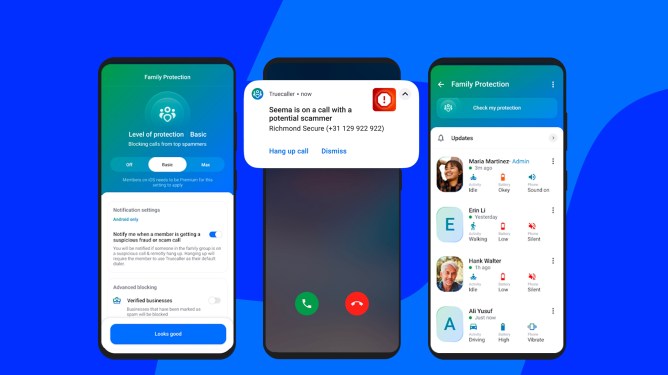
Truecaller has launched a new feature designed to protect families from scam calls. This feature allows one tech-savvy person to become the admin of a family or friends group of up to five members. The admin receives alerts about potentially fraudulent calls received by other group members. If the admin suspects a call is a scam, they can remotely end that call on the member’s behalf.
The feature was first introduced in December in a few countries, including Sweden, Chile, Malaysia, and Kenya. After seeing promising results, Truecaller has now rolled it out worldwide, including in India, which is the company’s biggest market. The feature is free and available even to users not on a paid Truecaller plan.
While the admin gets fraud alerts for members on both iOS and Android, the ability to remotely end a call is only available for members using Android devices. On Android, members can also grant the admin permission to see real-time activity like whether they are walking or driving, their battery level, and if their phone is on silent. Truecaller states this is helpful for monitoring elderly family members and contacting them only when it is safe.
Admins can also block specific phone numbers and international calling codes, and share this blocklist with the entire group. Truecaller emphasizes that admins cannot see the non-spam call history or SMS history of group members.
Company executives highlight the personal impact of phone fraud. Kunal Dua, Truecaller’s Chief Product Officer, noted that most people know someone in their circle who has been affected by scams, marking this feature as a fundamental shift in the company’s focus.
This family protection tool follows other recent innovations from Truecaller. Last year, the company introduced an AI-powered voicemail feature for Indian users. It is now exploring a similar AI approach for the family protection feature, which could alert the admin to the type of fraud call a member is receiving. The company is also researching AI that could screen calls and automatically disconnect them when scam-associated keywords, like “digital arrest,” are detected.
The launch addresses a growing problem, particularly in India, where scam calls have led to significant financial losses. Truecaller reported identifying over 7.7 billion fraud calls last year. Indian authorities have launched various initiatives to combat spam, including a controversial SIM binding policy that could affect apps like WhatsApp and Telegram.
Truecaller itself is navigating challenges. Its stock has fallen more than 80% in the past twelve months. In its Q4 2025 report, the company stated its operating profitability dipped 49% year-on-year, with ad revenue declining 31%. It also faces potential disruption from India’s Caller Name Presentation (CNAP) system, which displays a caller’s carrier-registered name. Truecaller argues that simply displaying a name does not reduce spam, maintaining that its platform offers more comprehensive, community-based protection.
Regarding CNAP, Truecaller CEO Rishit Jhunjhunwala commented that the partial rollout has so far had limited impact on user growth. He stated that while CNAP might eventually affect growth, consumers can use both services in parallel, with Truecaller providing additional context and solutions.