
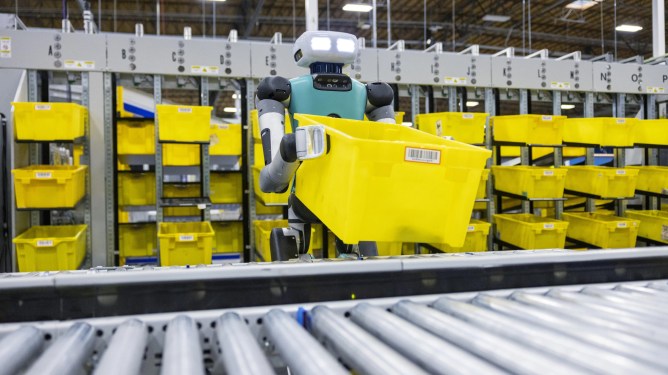
After a year-long pilot project, Toyota’s Canadian manufacturing subsidiary has hired seven humanoid robots to work in a plant building RAV4 SUVs. This arrangement is part of a robots-as-a-service deal.
Toyota Motor Manufacturing Canada President Tim Hollander stated that after evaluating several robots, the company is excited to deploy the Digit model to improve the team member experience and increase operational efficiency.
The Digit robot is built by Agility Robotics, a company spun out of Oregon State University. Digit is designed to work in industrial environments without direct human supervision, often bridging two different automated production lines. In this specific case, the robots will unload totes full of auto parts from an automated warehouse tugger.
While seven robots performing manual tasks may seem modest, the actual deployment of humanoid robots in real workplaces is rare and difficult. Demonstrating a capability in a lab is one challenge, but integrating it into a company’s workflow, including maintenance and charging, is another.
Industry experts note that a significant uptick in adoption will happen when tech companies deeply understand the real-world tasks and workflows. Agility Robotics is a leader in moving robots out of the lab, with its Digit robots already working for logistics providers like GXO, Schaeffler, and Amazon.
The company uses a proprietary cloud-based software called Arc to manage robot fleets and believes artificial intelligence will be vital in reducing deployment costs. Agility’s Chief Technology Officer has explained that the cost of deploying a robot can far exceed its purchase price, and AI tools are key to lowering that cost and configuration time.
Toyota Motor Manufacturing Canada and Agility will use this project to pioneer other applications that relieve human workers of repetitive physical tasks, allowing them to focus on more valuable work. Agility is also preparing a next-generation robot designed to operate safely alongside human workers. Current humanoid robots strong enough to lift heavy loads are still considered too unreliable for autonomous operation near people.
This move places Toyota among other companies testing humanoid robots in industrial settings. For example, competitor Figure AI tested its Figure 02 robots in a BMW factory for ten months, reportedly unloading 90,000 parts. Other companies running similar pilot programs include Apptronic, Unitree, Tesla, Boston Dynamics, 1X Technology, and Reflex Robotics.