
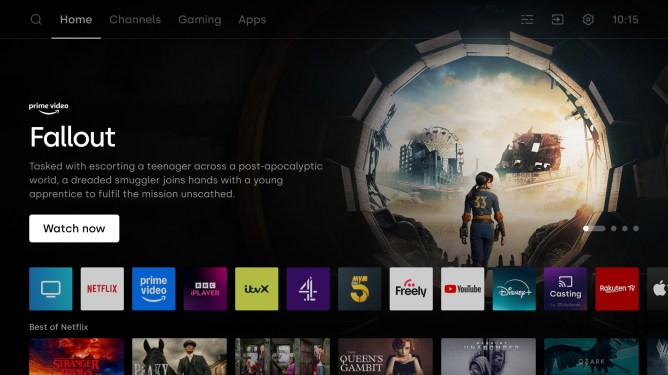
Television manufacturers face increasing pressure to derive greater lifetime value from each customer after the initial sale. In a competitive market where TVs are often sold at discounted prices with slim margins, the most effective way to recover revenue is through partnerships with channels, streaming services, and advertisers. This is the core idea behind Barcelona-based Titan OS, a company that provides a smart TV operating system to manufacturers with the promise of extracting better ongoing value from viewers.
Titan OS has announced a Series A funding round of 50 million euros, or approximately 58 million dollars. The investment was led by Highland Europe, with participation from Mangrove Capital Partners. While the company did not disclose its total funding to date, it noted that its 2023 seed round was in the double-digit millions.
The startup was founded in 2023 by Jacinto Roca, Timothy Edwards, Miquel Barba, and Tobias Pfalzgraff. Roca previously founded and sold a streaming startup called Wukai.tv to Rakuten, and the other co-founders have also held various roles at Rakuten.
Currently, Titan OS serves 18 million users, primarily across Europe and Latin America, through partnerships with brands like Phillips and JVC. The software is designed to simplify content discovery for viewers. This addresses a known challenge, as a 2023 Nielsen report highlighted that the time users spend searching for something to watch has increased. Titan OS aims to use data insights and its extensive content portfolio to reduce that time. The system provides access to a mix of broadcast TV, user-subscribed streaming apps, and free ad-supported television channels from its partners.
The company’s revenue model focuses on several key areas. First, it partners with numerous free ad-supported television services to help them reach local audiences. Second, it generates advertising revenue from placements on the TV home screen and during streams, reaching millions of users. Titan OS noted that content partners, especially those with sports and event-heavy channels, are eager to reach new audiences through these ads. The company also offers interactive shoppable ads, where viewers can scan a QR code to purchase items. Through these avenues, Titan OS claims its revenue has grown tenfold over two years.
While major TV makers like Sony may retain their core operating systems, they are open to partnerships with companies like Titan OS to offer more free ad-supported channels to their customers. Multiple industry reports suggest that for TV manufacturers, advertising is becoming a more lucrative revenue stream than hardware sales alone. Titan OS Chief Operating Officer Timothy Edwards agrees with this shift.
He explained that historically, hardware manufacturers made most of their profit from selling the device. Now, some manufacturers with their own operating systems make more profit from ongoing content and advertising revenues than from the hardware sale itself. What Titan OS offers TV companies is the ability to generate that ongoing content and advertising revenue after the device is sold, which represents a significant change from the market’s status quo.
To expand its European footprint, the company is strengthening its portfolio of local-language, ad-supported channels tailored to each geography. With this strategy, the startup competes with companies like Whale TV and Xperi’s TiVO, offering over 100 channels in these markets.
Titan OS currently employs 200 people across offices in Barcelona, Amsterdam, and Taipei. The new funding will be used to grow staff in product and sales, develop new partnerships, and create new advertising projects. The company aims to maintain its growth trajectory and plans to raise additional funding next year.
Laurance Garrett, a partner at lead investor Highland Europe, compared Titan OS to WeTransfer, a previous investment of the firm that was acquired by Bending Spoons. He noted that with Titan OS, the appeal is the advertising model layered on top of the core operating system, a concept familiar from their experience. Garrett added that with its European roots, Titan OS can better understand the nuances of local markets compared to international players entering from abroad.