
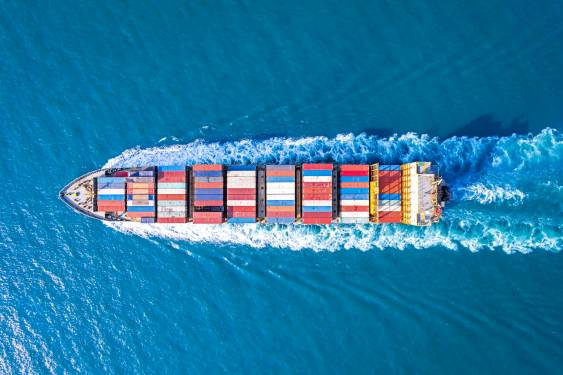
There is only one fusion device on earth that has been able to meet a key scientific threshold, but Maritime Fusion CEO Justin Cohen is already preparing to put a fusion reactor on a boat. Stay with me, because it is not entirely far-fetched. Thanks to advances in AI, computing, and superconducting magnets, fusion power is closer than ever to commercial reality. It is increasingly looking like fusion is more a question of when, not if. When it does happen, it promises to deliver large amounts of clean power from a plentiful fuel source, which is water.
Putting a reactor on a ship is not necessarily unreasonable either. Today, submarines and aircraft carriers powered by nuclear fission reactors routinely prowl the seas. They are quiet, powerful, and can operate for decades before they need refueling. The civilian sector even toyed with the idea of nuclear-powered cargo ships back in the 1960s and 1970s. Fission has definitely paved the way in terms of nuclear power on ships, Cohen said. Fusion promises to give ships similar capabilities but without concerns over meltdowns, proliferation, or radiation. For now, the sector has been focused on building the first reactors on land. Cohen stated he is pretty sure they are the first people to ever really look at what it is like to put a tokamak on a ship, referring to a leading fusion reactor design.
If fusion does pan out, then Maritime’s leap to the seas would put it ahead of the curve. Cohen argues it might actually be easier from a business perspective to start out at sea. The first fusion power plants will not be cheap, and it will take some time before they come down in cost. Competing against things like solar and wind on the grid is super challenging from a cost perspective, Cohen said. At sea, the economics look different. Ammonia and hydrogen are two leading contenders to replace diesel and bunker fuel on cargo ships, but they are still pretty pricey. Cohen noted that those are some of the other really expensive fuels that might actually be the only other things that are as expensive as first-of-a-kind fusion. In those cases, he said, they actually do compete, just straight up.
To flesh out its concept and start building parts for its first reactor, Maritime Fusion has raised four point five million dollars in a seed round. The round was led by Trucks VC with participation from Aera VC, Alumni Ventures, Paul Graham, Y Combinator, and several angel investors. The company was part of Y Combinator’s winter 2025 batch.
Maritime has begun assembling high-temperature superconducting cables from tape it buys from suppliers, which are mostly Japanese companies, Cohen said. Those cables will ultimately form the basis of powerful magnets the tokamak will need to confine the plasma required for fusion reactions. They will also be sold to other companies to generate revenue as Maritime develops its power plant.
The startup expects its first power plant, named Yinsen, will generate around thirty megawatts of electricity. Some of the biggest engineering challenges will be designing the support systems that harvest energy and keep the tokamak running, Cohen said. To simplify the onboard equipment, some of the ancillary tasks, like fuel processing, will be carried out on shore.
The first Maritime tokamak will be about eight meters across, and the startup is projecting it will be operational in 2032 and will cost around one point one billion dollars. For comparison, Commonwealth Fusion Systems, largely considered to be the leader in the fusion race, is building Sparc, a smaller tokamak at just under five meters across. The company has raised almost three billion dollars to date, much of which has gone toward building a demonstration plant, which it expects to bring online next year.
Sparc will not put power on the grid. Instead, its goal is to prove that tokamaks can generate more power than they consume. Commonwealth Fusion Systems’ full-scale, grid-powering reactor, Arc, will not be ready until the early 2030s. Commonwealth Fusion Systems has a considerable head start over many fusion startups, including newcomer Maritime. Yet Cohen is confident that will not be an impediment. He stated they are not going to spend billions on a breakeven-style device that does not produce energy on the grid. The first tokamak they build will be an energy-producing tokamak for a customer.