
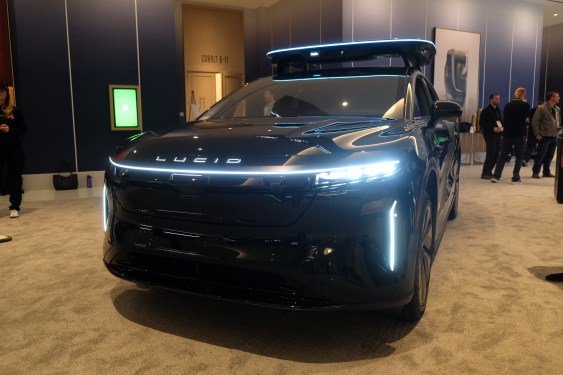
Uber, Lucid Motors, and Nuro have unveiled the production-intent version of their collaborative robotaxi at the 2026 Consumer Electronics Show. This vehicle is the result of a deal established over half a year ago, where Uber invested 300 million dollars into Lucid and committed to purchasing 20,000 of the company’s electric vehicles. The companies announced that the robotaxi is already undergoing testing on public roads, with a planned commercial service launch in the San Francisco Bay Area later this year.
The robotaxi is built on a Lucid Gravity SUV platform. Its autonomous driving system incorporates high-resolution cameras, solid-state lidar sensors, and radars integrated directly into the vehicle’s body and a roof-mounted sensor halo. This autonomy package is powered by Nvidia’s Drive AGX Thor computer. The halo also features integrated LED lights to help riders identify their vehicle, a function similar to that used by Waymo’s fleet.
A key advantage is that all this autonomous technology is integrated during the Gravity’s initial assembly at Lucid’s factory in Casa Grande, Arizona. This integrated approach saves time and money compared to the current method used by Waymo, which involves retrofitting its Jaguar I-Pace SUVs with autonomous systems after delivery.
The version shown at CES is a more polished iteration of the test vehicle the trio of companies has demonstrated over the past seven months. Newly revealed elements focus on the user interface. This includes a small exterior screen on the halo to greet riders and a comprehensive ride interface inside the cabin.
Passengers familiar with Waymo will find the experience similar. A rear passenger screen displays an isometric graphical view of the robotaxi navigating city streets, with visual representations of nearby cars and pedestrians. While an interactive version of the Uber-developed software was not yet available for testing, it is designed to show standard ride information such as estimated drop-off time, remaining trip duration, and controls for climate and music. The interface also provides buttons to contact rider support or instruct the vehicle to pull over.
The front passenger area features a larger central touchscreen displaying much of the same information. In the demonstration model, these elements were also visible on the Gravity’s sweeping 34-inch curved OLED display behind the steering wheel.
Uber selected the Lucid Gravity as the foundation for this forthcoming premium robotaxi service, a decision that appears sound given the SUV’s immense interior space, especially in the two-row configuration displayed. Uber has noted a three-row version will also be available.
The Gravity’s first full year of production, however, was not without challenges. Lucid contended with software issues as it ramped up manufacturing, problems that became significant enough for interim CEO Marc Winterhoff to send an apology email to owners in December. Lucid appears to have recovered, announcing on Monday that it doubled its 2024 production figures and achieved new sales records. It remains to be seen if the robotaxi variant will encounter similar software difficulties.
Uber, Lucid, and Nuro stated that once final validation of the robotaxi is completed later this year, true production versions will begin rolling off the assembly line in Arizona. The companies did not provide a specific timeline for this milestone.