
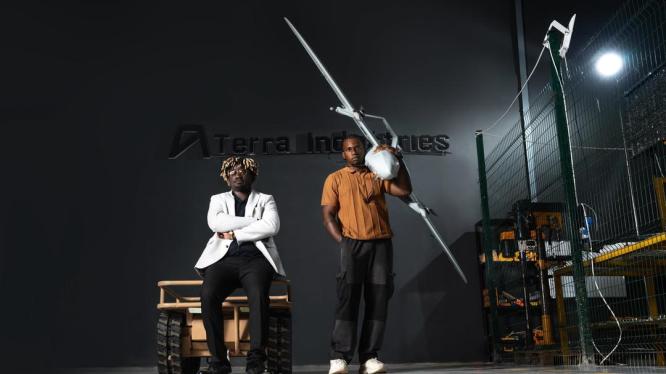
After five years of building an edtech company, 22-year-old Nathan Nwachuku realized Africa was at a crossroads. He observed the continent undergoing rapid industrialization, noting there is money, opportunity, and a young, driven population. He believed the continent was on the edge of an industrial revolution.
At the same time, he felt Africa still struggled to address one of its biggest Achilles heels: terrorism and insecurity. Africa has more terror-related deaths than any region in the world, a problem he said could slow down or even stop completely the region’s growth.
Nwachuku teamed up with his friend, 24-year-old Maxwell Maduka, and launched Terra Industries, a defense company that designs infrastructure and autonomous systems to help governments and organizations monitor and respond to threats. The company announced it emerged from stealth with an 11.75 million dollar funding round led by Joe Lonsdale’s 8VC. Other participants in the round include Valor Equity Partners, Lux Capital, SV Angel, and Nova Global.
The company previously raised an 800,000 dollar pre-seed round. Nwachuku said interest grew after the company appeared on CNN. African investors in the company include Tofino Capital, Kaleo Ventures, and DFS Lab.
Nwachuku, the company’s CEO, stated the goal is to build Africa’s first defense prime, constructing autonomous defense systems and other systems to protect critical infrastructure and resources from armed attacks. Maduka serves as the company’s CTO.
The team has significant military experience. Forty percent of its engineers held the same role in the Nigerian military. 8VC’s Alex Moore, who specializes in defense investing, is on the board, and Nigeria’s Vice Air Marshal Ayo Jolasinmi serves as an advisor. Maduka also served as an engineer in the Nigerian Navy and founded a drone company at age 19.
Based in Nigeria’s capital, Abuja, the company took a multi-domain approach to product development, considering how to protect critical infrastructure from the ground, water, and air. For the air, it produces long-range and short-range drones. On the ground, it has surveillance towers and ground drones. The company is still working on developing maritime technology to help protect infrastructure such as offshore rigs and underwater pipelines.
Terra powers its technology with its proprietary software, ArtemisOS, which collects, analyzes, and synthesizes data in real time. Once threats are spotted, it alerts response forces so they can intercept them. Nwachuku said they want to geofence all of Africa’s critical infrastructure and resources. He added that the problem is not a lack of firepower, as many African armies already have that, but a lack of sovereign intelligence, since much of the intelligence African countries depend on comes from Western powers, China, and Russia.
Nwachuku continued, stating they want to take the defense of the continent’s resources and infrastructure into Africa’s own hands, and that they are the first truly Pan-African defense company.
Terra recently won its first federal contract, though it cannot provide more details. The company makes money when governments and commercial customers place orders for its systems and then pay an annual fee for data processing and storage. Nwachuku said the company has generated more than 2.5 million dollars in commercial revenue so far and is protecting assets valued at around 11 billion dollars.
Commercial revenue comes from protecting private infrastructure, like gold mines or power plants. Terra said it is protecting at least two hydro power plants and several smaller mines, with most of its clientele coming from Nigeria.
The company hopes to use the new capital to help expand and build more defense factories across Africa. It also wants to further expand its software capabilities and grow its AI team. It will open software offices in San Francisco and London, but manufacturing will remain in Africa, with more factories opening across the continent to boost job creation.
Nwachuku concluded, “It’s clear Africa today is undergoing what I see as an epic struggle for its very survival. The only way for us to truly break ourselves from the shackles that have held us back for the last decade or two is ensuring the core resources, the core infrastructures of the continent, are entirely protected.”