
Fusion power has the potential to rewrite trillion-dollar energy markets. First, however, startups must prove their designs will work and will not be too costly. Neither task is easy. Many designs require massive magnets and lasers to be installed with millimeter precision or better.
The fusion startup Thea Energy says its pixel-inspired reactor and specialized control software should generate power without requiring that same level of perfection. According to co-founder and CEO Brian Berzin, the system does not have to be as perfect to begin with because the company has a way to tune out imperfections on the back end with software. This margin of error could give Thea an advantage.
Fusion power plants promise to deliver gigawatts of clean power, but material and construction costs threaten to make them uncompetitive with cheaper solar and wind. By building a power plant first and ironing out the kinks in software, Thea believes it can help bring the cost of fusion power down dramatically. But first, the company must build a working prototype.
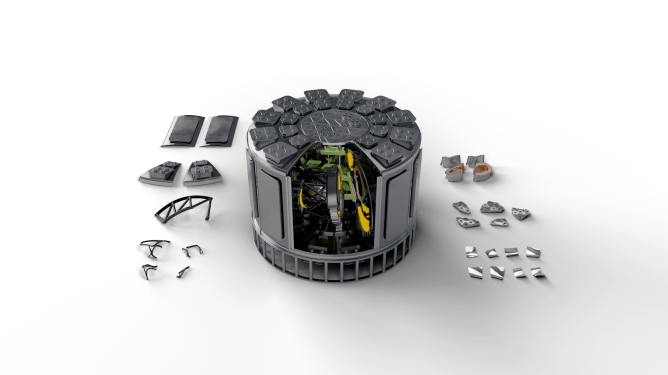
Thea is publishing the details of its design, including the underlying physics. The company is building a unique take on the stellarator, a type of reactor that uses magnets to shape and confine plasma fuel. Most stellarators use magnets of complex, irregular shapes. Thea’s design instead uses a dozen larger magnets and hundreds of smaller, identical ones to create what might be called a “virtual” stellarator.
Thea’s reactor uses small, identical superconducting magnets arranged in arrays. Software controls each magnet individually to generate magnetic fields that replicate a stellarator’s complex shape. This approach allows for rapid design iteration; the company has tweaked its magnet design more than 60 times in two years. It also lets software controls overcome irregularities in magnet manufacturing or installation.
To test its control system, Thea built a small array of magnets laced with sensors. The controls worked well. The team also trained an AI using reinforced learning to handle the task. In testing, they purposefully misaligned magnets and used defective materials from various manufacturers. Each time, the control system was able to tune out those defects automatically.
Thea’s reactor design, called Helios, will use two types of magnets. Twelve large magnets of four different shapes on the outside will do the heavy lifting to confine the plasma. Inside, 324 smaller circular magnets will fine-tune the plasma’s shape. The startup predicts Helios will generate 1.1 gigawatts of heat, which a steam turbine will turn into 390 megawatts of electricity. The reactor would shut down for an 84-day maintenance period once every two years, aiming for a capacity factor of 88 percent.
Helios remains in the conceptual phase. Thea must first build Eos, an initial fusion device to prove the science. The company will announce a site for Eos in 2026, with plans to turn it on around 2030. Work on Helios will proceed in parallel. This is a similar approach to other fusion companies building demonstration and commercial plants concurrently.
For now, Thea is releasing its overview paper and looks forward to feedback from the fusion community. This will be followed by substantial work released via peer review and publication. The company sees this as the moment to establish partnerships and collaborations to build its first reactor.