
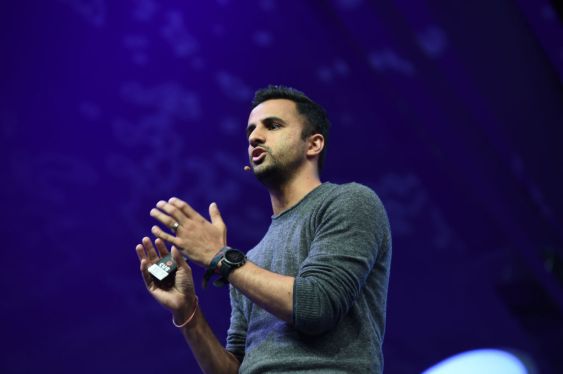
For months, there has been talk that Silicon Valley’s billionaire class was recruiting a candidate to take on Representative Ro Khanna. Early Tuesday morning, that candidate made it official. Ethan Agarwal, a 40-year-old tech entrepreneur with no political background, told TechCrunch on Monday evening that he is running for California’s 17th congressional district. That move is likely to set up what may become one of the most lavishly funded primary challenges of the 2026 election cycle.
The race puts a spotlight on Khanna, a 49-year-old Democrat widely seen as a possible 2028 presidential candidate. He has publicly backed a one-time wealth tax in California, an endorsement that has infuriated some of the state’s richest founders and investors. Khanna has doubled down, introducing national legislation with Senator Bernie Sanders that would impose a 5% annual wealth tax on all Americans worth $1 billion or more. Their offices estimate this proposal would raise $4.4 trillion over a decade.
There is a certain irony to the situation. Agarwal is a graduate of Wharton and spent three years at McKinsey before founding the audio fitness company Aaptiv, which he sold in 2021. He most recently co-founded the financial services startup Coterie, backed by Andreessen Horowitz.
When Khanna first ran for this same seat in 2014, he was the tech-backed outsider, with support from figures like Marc Andreessen, Sheryl Sandberg, and Eric Schmidt. He challenged popular Democratic incumbent Mike Honda, lost that attempt, but came back in 2016 to win. Critics at the time called Khanna an owned man. A decade later, the same charge will surely be leveled at the person trying to unseat him.
In an interview, Agarwal explained his decision to run. He had initially announced plans to run for governor of California when the field was thin, but later switched to the congressional race after stronger candidates entered. He cited Khanna’s incremental pivot to the left and his support for a wealth tax as the final motivation. Agarwal stated he believes he could have more impact by running in the 17th district.
On financial backing, Agarwal noted that while he could not yet formally raise money, he has support from figures like Y Combinator CEO Garry Tan and DoorDash co-founder Stanley Tang, with more names from the tech community expected to follow.
Agarwal outlined his policy alternatives to a billionaire tax. His proposals include taxing loans taken out against assets, considering an increase to California’s capital gains rate, and implementing significantly higher property taxes on homes held as investments rather than primary residences.
When asked about his top priorities if elected to Washington, Agarwal listed three: banning stock trading for members of Congress and their families, banning corporate PAC money, and imposing term limits. He also expressed a goal to eradicate childhood poverty in the 17th district.
Agarwal accused Khanna of being a prolific stock trader, claiming he made thousands of trades last year despite publicly supporting a trading ban. Agarwal pledged to divest his entire portfolio if elected. In response to these claims, it has been noted that Khanna has co-sponsored reform acts and has stated he does not personally trade stocks, attributing the activity to his wife’s independently managed trust.
On regulating technology, Agarwal said Section 230 of the Communications Decency Act, which shields social media platforms from liability for user content, made sense when drafted but may need revisiting concerning impacts on teenage mental health. He stopped short of advocating for full platform liability.
Regarding artificial intelligence, Agarwal emphasized the national security imperative of allowing American companies to build powerful AI models, arguing that over-regulation could cede advantage to China. He expressed openness to an independent, apolitical regulatory body similar to the FDA, provided it strengthened national security.
On prediction markets like Polymarket and Kalshi, Agarwal stated they are already regulated by the CFTC and that the current regulatory framework is sufficient.
Agarwal described his campaign as a full-time, ground-game effort focused on local engagement within the district, contrasting his approach with what he characterized as Khanna’s national profile-building. He framed the race as a choice between a national figure and a locally focused representative.
His impetus for entering politics, he said, stems from his family’s immigrant story and his belief that the system that enabled his success is no longer working for many hardworking people in his community.
Agarwal insisted this is not a career pivot. He pledged to self-impose a term limit of no more than five terms before likely returning to the private sector, stating that service should be a calling, not a career. This stance echoes the outsider message Khanna himself once championed.
Whether Agarwal succeeds may depend on whether Khanna develops political vulnerabilities. Currently, with his high-profile legislation and substantial campaign funds, Khanna appears to be fortifying his position.