
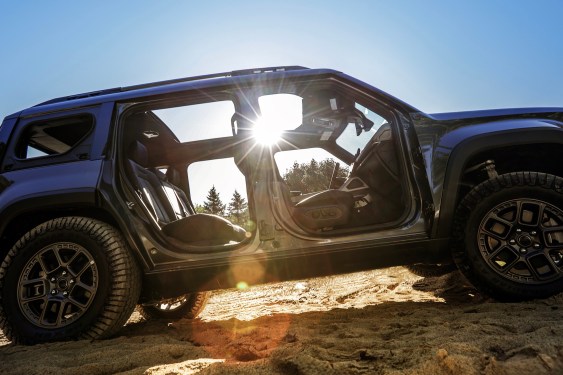
The Jeep Recon is here as an all-electric SUV with an estimated 250 miles of range, and its arrival is a genuine surprise. The story began three years ago when Jeep unveiled its plan to reshape its portfolio with the launch of three electric vehicles. Two of these models were scheduled to arrive in North America by 2024. The all-electric Jeep Recon and Wagoneer S were central to the brand’s strategy to dominate the electrified SUV market. At that time, parent company Stellantis aimed for electric vehicles to make up half of Jeep’s sales in North America and all of its sales in Europe by the year 2030.
While the Wagoneer S eventually came to market in early 2025, the Jeep Recon remained in limbo. During this period, most automakers, including Stellantis, which also owns Chrysler and Ram, began to backpedal on their ambitious electric vehicle plans as consumer demand failed to meet lofty forecasts. In September, Ram canceled its plans to produce a battery-electric full-size pickup truck, opting instead to focus on bringing an extended-range Ram 1500 REV to market. A month later, Stellantis announced a 13 billion dollar investment to strengthen its U.S. manufacturing over the next four years as part of a broader revival plan. Notably, this multi-billion-dollar commitment did not place electrification at its centerpiece.
Despite this industry shift, the Jeep Recon, with its distinct Wrangler styling, has survived. The company has revealed that the 2026 Jeep Recon, with a starting price of 65,000 dollars not including the 1,995 dollar destination fee, will go into production next year at the Toluca Assembly Plant in Mexico. It will launch first in the U.S. and Canada, followed by a global expansion.
The Recon is a four-wheel-drive electric vehicle that carries the Trail Rated badge, an off-roading designation that holds significant weight among enthusiasts. As a result, the vehicle comes standard with the brand’s Selec-Terrain traction management system, underbody protection, tow hooks, off-road tires, and e-locker axle technology. This system allows drivers to flip a switch and electronically lock the differential to ensure torque is delivered to both rear wheels, a handy feature for off-road driving.
The brand CEO stated that with the Jeep Recon, the company is proving that electrification is not just compatible with off-road excellence but can actually elevate it. He highlighted the benefits of instant torque, precision control, and a quieter, more connected driving experience that is uniquely Jeep.
The company also announced it is adopting the North American Charging System for select electric vehicles, including the Jeep Recon. However, the NACS system will not be integrated directly into the Jeep Recon. Owners will need to use a NACS adapter to access thousands of Tesla supercharging stations.
The powertrain includes a 100-kilowatt-hour battery pack that delivers 650 horsepower and 620 pound-feet of torque. This powerful combination enables the vehicle to accelerate from zero to 60 miles per hour in just 3.6 seconds. The reason one might want such performance in a Jeep remains an open question for some.
The larger question, which will not be answered until the vehicle comes to market, is whether SUV-loving Americans will buy it. This is especially pertinent when the base version of the iconic 2026 Wrangler starts at about 49,895 dollars. Perhaps the notable torque and power, combined with a slick interior that includes a 14.5-inch horizontal touchscreen, the largest ever for a Jeep, along with classic features like Wrangler-inspired LED taillamps, a swing gate, and removable doors, will be enough to convince buyers.