
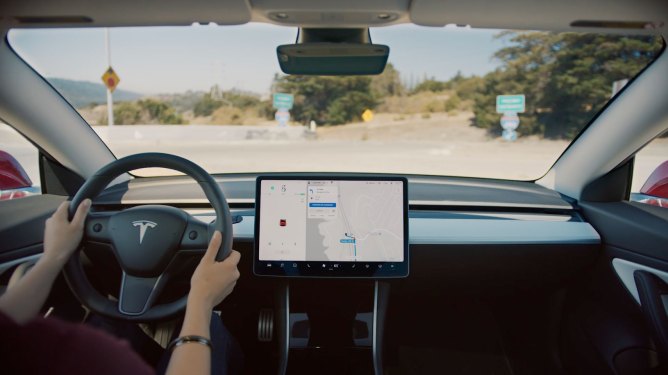
Tesla has discontinued Autopilot, its basic driver-assistance system. The company is making this move to boost adoption of its more advanced technology, called Full Self-Driving (Supervised). This decision coincides with Tesla facing a 30-day suspension of its manufacturing and dealer licenses in California, its largest U.S. market. A judge ruled in December that Tesla engaged in deceptive marketing by overstating the capabilities of both Autopilot and Full Self-Driving for years. The California DMV, which brought the case, stayed the ruling for 60 days to allow Tesla to comply by dropping the Autopilot name.
Autopilot was a combination of two features: Traffic Aware Cruise Control, which maintains a set speed and distance from cars ahead, and Autosteer, a lane-centering feature. Tesla’s online configuration now states that new cars come standard only with Traffic Aware Cruise Control. It is not clear if current owners are affected.
This change comes one week after Tesla announced it would stop charging a one-time $8,000 fee for the Full Self-Driving software, effective February 14. After that date, customers will only be able to access the technology through a monthly subscription costing $99. Tesla CEO Elon Musk stated that this subscription price will increase as the software’s capabilities improve.
Musk believes Tesla’s newer cars will eventually be capable of “unsupervised” driving, suggesting that advances in Full Self-Driving will allow drivers to be on their phone or even sleep during a ride. In December, he said a new version of the software allowed for texting, though that remains illegal in almost all states.
Separately, Tesla has rolled out the first robotaxi versions of its Model Y SUVs in Austin, Texas. These vehicles have no human safety driver inside and are running a more advanced version of the driving software. They are still followed by other company cars for supervision.
Tesla first launched a beta version of its Full Self-Driving software in late 2020, but adoption has lagged behind executive expectations. In October 2025, Tesla’s chief financial officer stated that only 12% of all Tesla customers had paid for the software. Achieving “10 million active FSD subscriptions” by 2035 is a key requirement for Musk to receive the full payout of his new $1 trillion compensation package.
Tesla originally introduced Autopilot in the early 2010s after talks broke down between Musk and Google about using the search giant’s autonomous driving technology. Tesla made the driver assistance system standard on all its vehicles in April 2019.
Throughout Autopilot’s existence, Tesla struggled to clearly communicate the software’s limitations. The company often overpromised, making the technology seem more capable than it was. This led some drivers to become overly confident, resulting in hundreds of crashes and at least 13 fatalities, according to the National Highway Traffic Safety Administration.