
Welcome back to TechCrunch Mobility, your central hub for news and insights on the future of transportation.
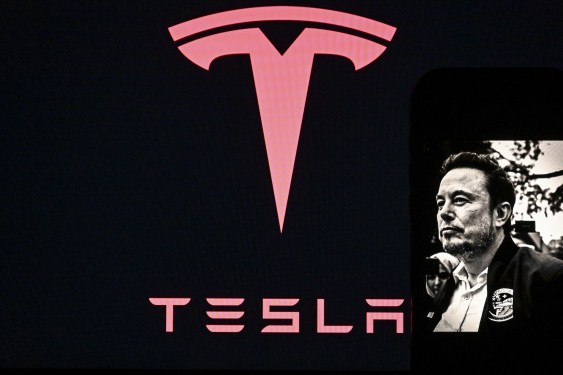
Tesla CEO Elon Musk has spent years trying to position his company as more than just a maker of electric vehicles. Following the 2016 acquisition of SolarCity, it was pitched as a sustainable energy company. Over the past year, the focus has shifted to framing Tesla as an AI and robotics company. However, this aspirational branding collides with financial reality: the bulk of its revenue still comes from selling EVs.
The latest earnings report underscores this point. Tesla generated $94.8 billion in revenue in 2025. Of that total, $69.5 billion came from selling and leasing EVs, along with related regulatory credits. The remaining $25 billion is split nearly evenly between its energy generation and storage business and its “services and other” segment, which includes revenue from Superchargers, parts sales, and Full Self-Driving subscriptions.
This reliance on vehicle deliveries means that as EV sales have dipped, so has Tesla’s entire balance sheet. Its profits in 2025 were 46 percent lower year-over-year.
In response to declining sales, Tesla is attempting to grow its non-EV businesses. Its recent quarterly and full-year earnings report signaled a shift from talk about AI and robotics toward concrete action. For now, that action involves significant spending rather than profit. Musk repeatedly stressed that 2026 will be a major capital expenditure year, with plans to more than double spending. This level of investment is expected to push the company into negative cash flow territory.
In a symbolic move, Tesla announced it is ending production of the Model S and Model X. These two models represent only about 2 percent of Tesla’s sales volume, marking a notable end of an era for the company and the industry that was transformed when the Model S launched in 2012.
More materially, Tesla plans to fill the production capacity freed up by those models with its Optimus humanoid robots, to be manufactured at its Fremont, California factory. Musk also intends to scale Tesla’s robotaxi operations to more cities in 2026 and has suggested the need for a new factory to secure chip supply.
A particularly notable move is Tesla’s plan to invest $2 billion into another Musk company, xAI, signaling a closer alignment between the two firms. Meanwhile, reports indicate talks are underway about a possible merger of three Musk companies: SpaceX, Tesla, and xAI.
Returning to Tesla’s current business, its vehicle sales are down year-over-year, while its smaller energy storage division has posted positive gains.
In other industry news, autonomous vehicle startup Waabi raised $750 million in a Series C round, plus an additional $250 million in milestone capital from Uber. This deal supports the deployment of over 25,000 Waabi-powered robotaxis on Uber’s platform, marking Waabi’s expansion from self-driving trucks into robotaxis.
Gatik AI, a startup focused on autonomous middle-mile trucking, signed a deal with a major consumer-goods company expected to deliver $600 million in revenue over five years. These operations are fully driverless.
Luminar’s lidar business was sold for $33 million to MicroVision, following a sales process that included a last-minute mystery bidder.
Rad Power Bikes reached a deal to sell itself for approximately $13.2 million as part of its bankruptcy process. The company had previously raised over $329 million and once held a $1.65 billion valuation.
Redwood Materials raised $425 million in a Series E round, attracting Google as a new investor alongside others like Nvidia’s venture arm.
In ride-hailing developments, data indicates the price gap between Waymo robotaxis and services from Uber and Lyft is narrowing in the San Francisco Bay Area. Uber launched a new division, Uber AV Labs, to collect and share driving data with robotaxi partners like Lucid, Waymo, and Waabi.
Waymo has received permission to operate a robotaxi service to and from San Francisco International Airport, beginning with a select group of riders. This milestone is tempered by an ongoing investigation after one of its robotaxis struck a child near a school in Santa Monica. Separately, the San Francisco Police Department is investigating an incident involving a Zoox autonomous vehicle that collided with a parked car.