
Welcome back to TechCrunch Mobility, your central hub for news and insights on the future of transportation.
Senior reporter Sean O’Kane visited Palo Alto to cover Rivian’s Autonomy and AI Day, an event some insiders called the company’s most important. While the presentation was filled with buzzwords, the core message was clear: Rivian is building a company about more than just selling cars. It is not going as far as Tesla, with no humanoid robots in sight, but it is actively developing new revenue-generating products, starting with advanced driver assistance.
Rivian’s current hands-free driver-assistance software, usable on about 135,000 miles of road, is set to expand to 3.5 million miles and include surface streets. This expanded capability, launching in early 2026, will eventually offer point-to-point hands-free driving, though drivers must keep their eyes on the road. It will cost $2,500 upfront or $49.99 per month.
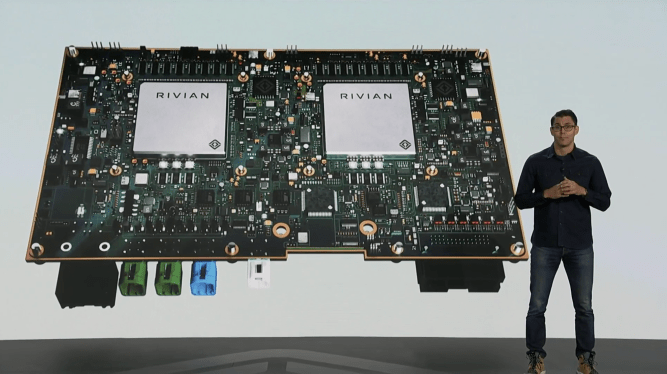
Looking further ahead, Rivian revealed a future hands-off, eyes-off system. The company has developed its own custom 5nm processor in collaboration with Arm and TSMC. This chip will power Rivian’s autonomy computer, the backbone of an upgraded automated-driving system debuting in the R2 SUV in late 2026. This will likely be an additional cost, though Rivian did not specify if it would exceed the $2,500 fee.
Another potential revenue stream is licensing its technology to others. Rivian already has a joint venture with Volkswagen Group to share electrical architecture and software. This year, it spun out two startups: Also for mobility and Mind Robotics for industrial AI and robotics. Analysts have noted potential for Rivian to license its entire autonomous vehicle platform or components like its custom processor. When asked if Rivian would sell the processor to Mind Robotics, CEO RJ Scaringe responded wryly that it didn’t take much imagination.
At its core, adding new revenue lines to the car business makes financial sense.
In other news, while there were no specific tips to share this week, a behind-the-scenes note from the Rivian event revealed some tension. Before the public demo of its AI assistant, testing was touch and go. The demo proceeded successfully after one tense moment at the start, a risk many companies avoid.
On the deals front, aircraft startup Boom Supersonic is ending 2025 with a plan to sell a version of its turbine engine as a stationary power plant. Its first customer, data center startup Crusoe, will buy 29 turbines for $1.25 billion. Boom raised $300 million to commercialize this new business, with plans to use the revenue to fund its supersonic aircraft development.
Elsewhere, self-driving truck company Aurora Innovation made a commercial agreement with Detmar Logistics to autonomously transport materials in the Permian Basin. The joint venture between Ford and battery maker SK On is ending, with the companies dividing assets: Ford will take the Kentucky plants, and SK On will operate the Tennessee factory. Additionally, underwater autonomous vehicle startup Vatn Systems raised $60 million in a Series A round.
Notable reads include a data breach at auto credit check giant 700Credit affecting at least 5.6 million people. NASA and the US Postal Service have stopped using vans from the bankrupt EV startup Canoo. Ford and Renault are teaming up to bring two affordable Ford-branded EVs to Europe in 2028. Lucid Motors is being sued by its former chief engineer for wrongful termination and discrimination. Subaru unveiled its Uncharted EV with a 300-mile range and a starting price just above $36,000.
In autonomous vehicle news, a pregnant woman gave birth inside a Waymo robotaxi in San Francisco. A leaked investor letter revealed Waymo is now providing 450,000 robotaxi rides per week. Meanwhile, car-share company Zevo plans to add robotaxis to its fleet, starting with newcomer Tensor.
Finally, in a recent reader poll about the pace of autonomous vehicle development, about 48% of respondents voted for companies to stay the course. Nearly 23% chose to scale faster, while 29.4% preferred companies to tap the brakes.