
Welcome back to TechCrunch Mobility, your central hub for news and insights on the future of transportation.
We are in the midst of one of my four favorite times of year: earnings season. I enjoy these numbers because the required filings cut through a lot of the marketing noise presented by companies the rest of the year. They also help me assess the short- and long-term stakes the companies face.
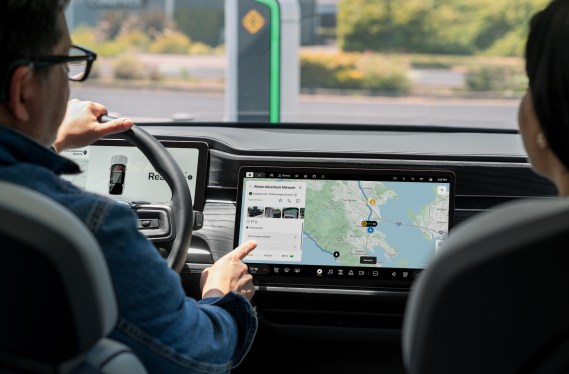
Rivian’s fourth-quarter and full-year earnings did precisely that. My takeaway is that software, and specifically its technology joint venture with Volkswagen Group, was the company’s savior in 2025. It will also buoy the company into 2026, as another two billion dollars is expected from VW Group, while Rivian launches its most important product to date: the lower-cost R2 SUV.
The company’s earnings also provided a progress report on its bid to lower the cost of goods sold per unit. The summary is that the cost per unit for its current portfolio is still high but dropping, meaning it is losing less on each vehicle it sells. According to Rivian, the company’s automotive cost per unit delivered was one hundred thousand nine hundred dollars in 2025, down from one hundred ten thousand four hundred dollars in 2024.
The upcoming R2, which is supposed to be considerably cheaper in both production cost and price tag than its flagship R1T truck and R1S SUV, will be the next big test. We will get some insight into the results of that later this year.
The R2 is expected to go into production in the first half of the year, and based on its guidance for 2026, Rivian is confident it has the demand and the ability to ramp production. The company expects to deliver between sixty-two thousand and sixty-seven thousand vehicles in 2026, which could provide up to a fifty-nine percent bump from last year. Rivian delivered forty-two thousand two hundred forty-seven vehicles in 2025, which includes its two R1 consumer vehicles and the electric delivery van.
The market loved that guidance. Rivian stock shot up twenty-seven percent in the day after it reported earnings.
Over the past eighteen months, I have noticed a divergence in how Uber and Lyft are approaching autonomous vehicles. Uber is locking up autonomous vehicle partnerships with every player it can. Lyft is trailing behind. Turns out, I am not alone in this observation.
Insiders have shared their puzzlement about why Lyft has not been more aggressive on this front. They noted that Lyft is sitting on about one point eight billion dollars in cash, cash equivalents, and restricted cash, and recently announced a new one billion dollar share repurchase program. That has some wondering why Lyft did not invest in parts of the autonomous vehicle value chain like Uber is doing versus buying shares back.
Meanwhile, these sources also pointed to a few top executives who have departed over the past year. Aurélien Nolf left his position as Vice President of financial planning and analysis and investor relations to become Chief Financial Officer of Navan. Audrey Liu, who was an executive Vice President and head of rider and community safety, is now at Adobe. Ameena Gill, who was Vice President of safety and customer care, just took a job at rival Uber.
Close followers of the mobility-crazed years between 2015 and 2019 might recall how many lidar companies popped up during that time. Many of the dominant and buzziest ones have since shuttered, while some of the smallest players have hung on and expanded.
Take Ouster, for instance. I remember when Ouster had a tiny booth in the jam-packed startups area at CES. Today, the company is much bigger thanks to scale, its 2022 merger with rival Velodyne, and its acquisition of Sense Photonics in 2021. And it does not appear to be finished.
The company most recently acquired Stereolabs, a company that makes vision-based perception systems for robotics and industrial applications, for a combination of thirty-five million dollars and one point eight million shares. This deal is the latest in a march toward consolidation among perception sensor suppliers. Just last month, MicroVision bought the lidar assets of the buzzy-but-now-bankrupt Luminar for thirty-three million dollars.
So why all the activity? From my point of view, the frenzy around physical AI has reignited interest and investment in sensor technologies, particularly cameras.
Other deals that got my attention include Ever, the electric vehicle-only marketplace, which raised thirty-one million dollars in a Series A funding round led by Eclipse. Also, Natilus, the San Diego-based startup developing blended-wing aircraft, raised twenty-eight million dollars in a Series A funding round led by Draper Associates.
Aurora shared in its fourth-quarter and full-year earnings report that its self-driving trucks can now travel nonstop on a one-thousand-mile route between Fort Worth and Phoenix, exceeding what a human driver can legally accomplish.
The United States Securities and Exchange Commission closed its investigation into Fisker last year, as learned through a Freedom of Information Act request.
Lyft has launched teen accounts, a product that allows minors as young as thirteen to hail a ride without an adult in two hundred United States cities, including Atlanta, Boston, Chicago, and New York.
A fresh batch of videos gives us the best look at how Rivian has changed the rear door manual release on its upcoming R2 SUV. This seemingly minor design detail has life-or-death stakes and comes as the electric vehicle industry, and particularly Tesla, is getting pressure to change concealed, electronic door handles.
The Trump administration officially repealed the Environmental Protection Agency’s 2009 endangerment finding, which found that greenhouse gases such as carbon dioxide and methane were a threat to human health and welfare. This change would only affect tailpipe emissions for cars and trucks if the EPA makes it through the lengthy process of repealing the law, which will certainly include numerous lawsuits aimed at stopping it.
Uber has locked in a couple dozen autonomous vehicle partnerships, and we are starting to see the results of those deals. China’s Baidu and Uber plan to launch robotaxis in Dubai in the next month, starting with select locations within the Jumeirah area. Meanwhile, Chinese robotaxi company WeRide and Uber announced a major expansion of their strategic partnership to deploy at least one thousand two hundred robotaxis across the Middle East through 2027. As part of this, WeRide and Uber have launched a robotaxi service in downtown Abu Dhabi.
Waymo pulled the human safety driver from its autonomous test vehicles in Nashville as the Alphabet-owned company moves closer to launching a robotaxi service in the city. Meanwhile, this tech-forward company is wrestling with the analog problem of ensuring the doors of its robotaxis are properly shut. Its solution is to pay DoorDash gig workers to shut Waymo robotaxi doors. Waymo says this is a pilot program in Atlanta to enhance its autonomous vehicle fleet efficiency.
One final Waymo item: The company is starting to roll out its sixth-generation Waymo Driver, which is integrated into the Zeekr RT and will eventually be in the Hyundai Ioniq 5. Waymo has started fully autonomous operations in this vehicle in San Francisco and Los Angeles and is giving access to employees. The public will have to wait for a bit.
Rivian has pitched its upcoming R2 SUV as a more affordable model. What does more affordable mean? The company has thrown around forty-five thousand dollars and fifty thousand dollars as a base price. The company’s launch version of the R2, which will be a dual-motor and all-wheel-drive premium trim, will undoubtedly be more expensive. In our newsletter this week, we asked readers for their guess on the cost of the launch edition.