
Welcome back to TechCrunch Mobility, your hub for all things future of transportation.
It has been a minute, folks. The newsletter took a holiday break, but we are back and well into 2026. A lot has happened since the last edition. I spent the first week of the year at the Consumer Electronics Show in Las Vegas. It is worth repeating a point from last year: U.S. automakers have left the building.
What filled the void in the Las Vegas Convention Center? Autonomous vehicle tech companies like Zoox, Tensor Auto, Tier IV, and Waymo, which recently rebranded its Zeekr robotaxi. Chinese automakers like Geely and GWM were also present, alongside software and automotive chip companies, and loads of what Nvidia CEO Jensen Huang calls “physical AI.”
This term, sometimes called “embodied AI,” describes the use of AI outside the digital world and into the real, physics-based one. AI models, combined with sensors, cameras, and motorized controls, allow a physical thing—a humanoid robot, drone, autonomous forklift, or robotaxi—to detect and understand its real environment and make decisions to operate within it. This technology was everywhere, from agriculture and robotics to autonomous vehicles, drones, industrial manufacturing, and wearables.
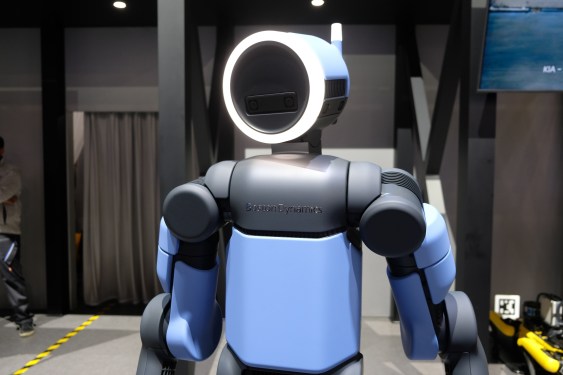
Hyundai had one of the busiest and largest exhibits, with a near-constant line wrapped around the entrance. The Korean automaker was not showing cars. Instead, it featured robots of various forms, including the Atlas humanoid robot from its subsidiary Boston Dynamics. There were also innovations from the Hyundai Motor Group Robotics LAB, like a robot that charges electric autonomous vehicles and a four-wheel electric platform called the Mobile Eccentric Droid that is going into production this year. It seemed everyone was embracing and showcasing robotics, particularly humanoids.
The hype around humanoids and physical AI was palpable. I asked Mobileye co-founder and president Amnon Shashua about this, as his company just bought a humanoid robotics startup for $900 million. When asked what he says to people who call humanoid robots all hype, Shashua replied, “The internet was also a hype, remember in 2000, the crisis of the internet. It did not mean that the internet is not a real thing. Hype means that companies are overvalued for a certain period of time, and then they crash. It does not mean that the domain is not real. I believe that the domain of humanoids is real.”
A few notable stories from CES include Nvidia launching Alpamayo, open AI models for autonomous vehicles; Uber revealing its new robotaxi from Lucid and Nuro; and Mobileye acquiring humanoid robot startup Mentee Robotics for $900 million.
Now onto other non-CES and more recent news.
President Trump made comments this week at a Detroit Economic Club meeting about welcoming Chinese automakers into the United States that did not sit well with many in the auto industry, according to insiders. I have been told the industry lobbying group, the Alliance for Automotive Innovation, is concerned. Trump said, according to reporters in attendance, “If they want to come in and build a plant and hire you and hire your friends and your neighbors, that’s great, I love that. Let China come in, let Japan come in.”
A couple of notes. Japanese companies like Toyota are already established in the United States. The bigger hurdle, beyond protests from U.S. automakers, is existing law. In 2025, a U.S. rule restricted the import and sale of certain connected vehicles and related hardware and software linked to China or Russia, essentially banning the sale of Chinese vehicles in the country.
Avery Ash, CEO of SAFE, a nonpartisan organization focused on securing U.S. energy and supply chains, weighed in on the dangers of allowing Chinese automakers to sell in the United States. He stated, “Welcoming Chinese automakers to build cars here in the U.S. will reverse these hard-won accomplishments and put Americans at risk. We’ve seen this strategy backfire in Europe and elsewhere — it would have potentially catastrophic impacts on our automotive industry, have ripple effects on our entire defense industrial base, and make every American less secure.”
Meanwhile, Canada is opening the door to Chinese automakers. Canadian prime minister Mark Carney announced his country will slash its import tax on Chinese EVs from 100% to just 6.1%.
In deal news, budget carrier Allegiant agreed to buy rival Sun Country Airlines for about $1.5 billion in cash and stock. Dealerware, which sells software services to automotive companies, was acquired by a group of investors led by Wavecrest Growth Partners and Radian Capital. Long-distance bus and train provider Flix acquired a majority share of European airport transfer platform Flibco.
JetZero, a startup developing a fuel-efficient triangular aircraft, raised $175 million in a Series B round. Joby Aviation, developing electric air taxis, reached an agreement to buy a large manufacturing facility in Ohio to support increased production. Luminar has reached a deal to sell its lidar business to Quantum Computing Inc. for $22 million, a notable sum given Luminar’s valuation once peaked at $11 billion.
In other notable reads, a security researcher found that shipping software company Bluspark Global had a platform vulnerable and open to anyone on the internet. The Federal Trade Commission finalized an order banning General Motors and its OnStar service from sharing certain consumer data with reporting agencies.
InDrive, the ride-hailing platform that lets users set the price, is diversifying into a “super app” strategy with more in-app advertising and expanding grocery delivery to Pakistan. Motional, the majority Hyundai-owned autonomous vehicle company, has rebooted with a new AI-first approach as it targets a driverless service in 2026.
New York governor Kathy Hochul plans to introduce legislation to effectively legalize robotaxis in the state, with the exception of New York City. The proposal aims to expand the state’s existing autonomous vehicle pilot program.
Tesla is ditching the one-time fee option for its Full Self-Driving software and will now only offer access through a monthly subscription. Finally, on-demand drone delivery company Wing is expanding its service to another 150 Walmart stores as part of an expanded partnership.