
Last year, fusion power startup General Fusion faced significant financial difficulties. The company laid off at least a quarter of its staff as it struggled to raise funds. It received a critical twenty-two million dollar lifeline investment while it worked to keep the company afloat.
Today, General Fusion has revealed its survival plan. The company will go public through a reverse merger with a special purpose acquisition company called Spring Valley III. This move is combined with additional investment from institutional investors. It marks a significant change in fortunes for a company whose CEO wrote a public letter just last year pleading for funding.
If the deal closes as planned, General Fusion could receive up to three hundred thirty-five million dollars from the transaction. This is more than double what it was reportedly seeking to raise last year before it secured the twenty-two million dollar lifeline. The transaction will value the combined company at approximately one billion dollars.
Before this merger was announced, the fusion startup, which was founded in 2002, had previously raised over four hundred forty million dollars according to PitchBook.
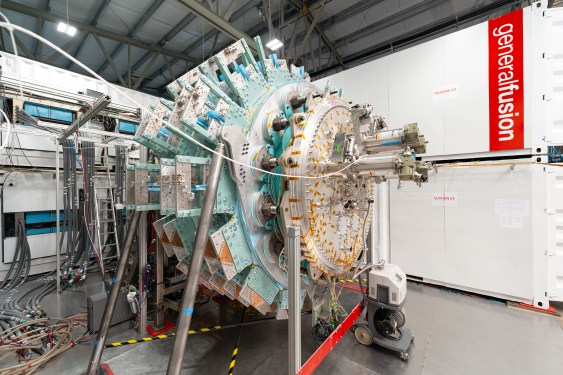
General Fusion plans to use the new money to complete its demonstration reactor, known as Lawson Machine 26, or LM26. The device uses an approach called inertial confinement. This method works by compressing a fuel pellet until its atoms fuse together, releasing energy in the process. The National Ignition Facility used inertial confinement in its successful fusion experiments, employing lasers to bombard fuel pellets.
LM26 does not use lasers. Instead, it uses steam-driven pistons that drive a wall of liquid lithium metal inward to compress the fuel pellet. That liquid lithium then circulates through a heat exchanger, which generates steam to spin a generator. By avoiding expensive lasers or superconducting magnets required in other fusion reactor designs, General Fusion hopes to build a fusion power plant for less money. But first, the company must prove its approach is viable.
Last year, before revealing its financial problems, General Fusion stated that LM26 would achieve scientific breakeven in 2026. Scientific breakeven is when a fusion reaction generates more power than was required to start it. This is a key milestone, though distinct from and easier to attain than commercial breakeven, where fusion reactions release enough energy to export electricity to the grid. General Fusion did not reply to a request asking if this timeline had changed.
The acquisition company, Spring Valley, is something of a specialist in reverse mergers with energy companies. It previously took NuScale Power, a small modular nuclear reactor company, public in a deal whose stock price has since fallen more than fifty percent from its peak last year. The firm is also completing a merger with Eagle Energy Metals, a uranium mining company that is reportedly developing its own small modular reactor.
General Fusion is not the first fusion company to go public. In December, TAE Technologies announced it would merge with Trump Media & Technology Group in a deal valuing the combined company at more than six billion dollars.
A common thread connecting these deals is data centers. They are expected to consume nearly three hundred percent more power by 2035, according to BloombergNEF. General Fusion explicitly points to rising data center energy demand in its merger announcement. The company also pointed to broader electrification trends, including electric vehicles and electric heating, that could increase overall electricity demand by up to fifty percent by 2035. This is a reminder that, while some have cast doubts on an electrified future, other countries are charging ahead. While General Fusion may face technological challenges, trends in the energy world suggest that if it can deliver fusion power at a reasonable cost, it will find plenty of willing buyers.