
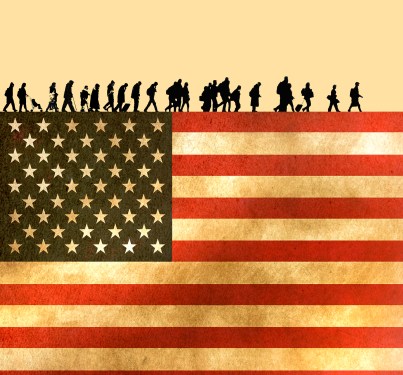
Amr Awadallah, founder of AI startup Vectara, had two reactions when he heard about changes to the H-1B visa program that raise the application fee for each visa to one hundred thousand dollars. He was not surprised. But he was dismayed. He stated that he cannot afford to pay that amount. Awadallah has hired one employee on an H-1B, and while the new fee only applies to new applications, he believes it is too high for many startups and will price them out of hiring internationally.
The H-1B visa was created to allow companies to hire skilled talent from a worldwide market for such occupations as IT and engineering. On Friday, President Trump announced that the fee hike, typically paid by the employer, would increase from two to five thousand dollars to one hundred thousand dollars per application. This change will especially be felt with the new batch of visas available in March.
Immigration is a key issue for President Trump, who, even dating back to his 2016 campaign run, accused companies of using the H-1B to take jobs from U.S. citizens. Critics of the fee hike note that this visa helped bring in people who have gone on to start or run multibillion-dollar companies. Former holders include Google’s Sundar Pichai, Microsoft’s Satya Nadella, and Elon Musk. The visa has been more accessible than the O-1 visa for extraordinary ability and quicker to obtain than a green card.
Awadallah said the impact will be severe on the competitiveness and innovation of smaller startups compared to the hyperscales, the big businesses. While Big Tech can more easily afford such fees, he feels that startups will miss out. He believes that pricing startups out will impact innovation in very negative ways longer term.
More than seven hundred thousand people live in the U.S. on an H-1B, and they have brought with them more than five hundred thousand dependents, such as spouses, who are permitted to work under this visa, and children, according to the immigration advocacy group fwd.us. Indian nationals are the largest recipients of the visa, followed by China and the rest of the world, according to U.S. Citizenship and Immigration Services.
Only eighty-five thousand new people a year can receive the visa, and twenty thousand of them must have just graduated from a U.S. university. Demand outstrips availability, so H-1Bs are allocated at random in a lottery held in March. Tech companies have lobbied for years for an increase in annual H-1B limits. Critics allege that these companies are using H-1B holders to replace U.S. workers with lower-paid employees from overseas. Others say it exploits foreign workers, as the visa is tied to the employer, so workers cannot easily switch jobs and they face deportation if they lose their jobs.
Those who support the visa fee hike said that it could eliminate the lottery because the costs are now so high that employers would limit their applications. Of the eighty-five thousand new H-1B visas issued each year, about fifty-five thousand go to computer-related jobs. Previously, the total cost of hiring these workers fell between two hundred million and four hundred million dollars, but under the new fee, it would cost the tech industry five and a half billion dollars a year to hire H-1B tech workers.
Under the proposed changes, the minimum salary employers must pay an H-1B recipient will also increase, a change touted to help prevent the undercutting of U.S. citizen worker salaries. But many questions still loom. For instance, immigration lawyer Sophie Alcorn, who works with startups, said it is unclear whether the one hundred thousand dollars would be returned to the payer if an application is denied. As the price hike technically went into effect on Friday, it is also unclear if visa petitions currently under review are subject to it. She said this is forcing her firm to pause numerous H-1B petitions for aspiring founders while they wait for more guidance.
Silicon Valley founders say they look worldwide because there is a shortage of technical talent in the U.S., especially for skills like AI engineering. Brian Sathianathan, co-founder and CTO of the AI company Iterate, has a handful of employees on the visa and credits it for his previous successful startup exit. He said his last company, which he co-founded and sold, had a co-founder and a head of engineering on H-1B visas, which would not have been possible with such high fees.
Other founders warn that the fee sends a signal that foreign talent might not be welcomed. Hemant Mohapatra, an India-based partner at Lightspeed Venture Partners, was on an H-1B for around fifteen years. He said expensive barriers for tech-worker visas could leave an innovation gap in the U.S. startup ecosystem because a large percentage of highly valued companies are founded by immigrants. He noted that people brought to the U.S. on an H-1B often later start their own companies, and sometimes their children become founders too.
That is the experience of Jeffrey Wang, the co-founder of AI company Exa.ai. While a few of his workers obtained H-1B visas from a previous employer, Wang’s parents immigrated to the U.S. as H-1B recipients. He said the news makes him kind of sad, as he feels people like his parents would not be able to come to America anymore. The Trump administration said the visa change was to protect national interests, but Wang believes bringing the best talent to the U.S. helps with the nation’s security. He stated that as a nation of immigrants, nearly every important engineering or scientific achievement in the U.S. has involved immigrants.
U.S. startups are now scrambling. Some want exceptions carved out for startups. The administration said exemptions were possible in cases of national interest. Meanwhile, visa consultation company Cesium reported a more than fifty percent increase in early-stage founders looking at O-1 visas, though spouses cannot work on this visa. Later-stage companies are looking at the EB-1A visa, typically given to those at the top of their fields, which permits spouses to work.
Jack Thorogood, the CEO and founder of payroll company Native Teams, said his company has tracked a fifty percent increase in U.S. companies exploring visa-free global hiring options, like international remote work. He noted that one H-1B hire will now equal up to twenty remote hires in many other countries. He believes U.S. startups will just start outsourcing talent or keeping their workers abroad, as it would not be any more expensive to have talent overseas.
Markets like Canada, Germany, and the U.K. are already burgeoning tech hubs serving as landing spots for companies opening international offices. Oliver Kent-Braham, CEO and co-founder of the U.K.-based unicorn Marshmallow, said that if the U.S. is raising barriers, the U.K. and others should adapt accordingly to harness the amazing talent that exists from all corners of the world. Canadian Daniel Wigdor, an AI founder and professor at the University of Toronto, agreed that the visa fee change was not a good step for the U.S. He said instead of competing for the world’s best, they are testing how much companies will pay to import them. He believes that stance might play domestically, but it risks undercutting America’s global tech dominance.