
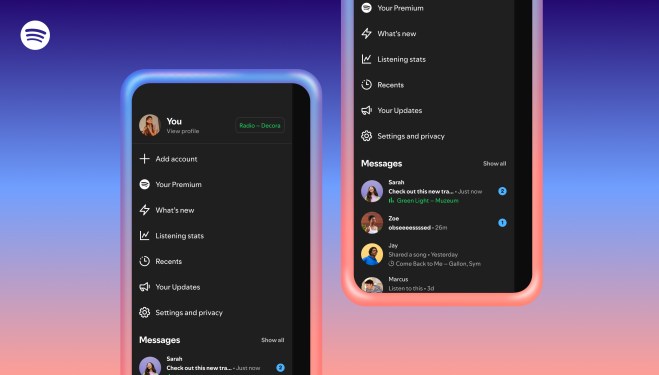
Spotify is adding even more social features to keep users from leaving the app to share music. The company announced it is introducing a new Messages feature that lets users see what their friends are streaming in real time and send requests to start Jams, the app’s collaborative listening feature.
To use this, users first need to go to their Settings and turn on the “listening activity” feature in the “Privacy & Social” section. Once enabled, your listening activity will appear at the top of Messages chats. You can tap a friend’s listening activity to play the track, save it, open the menu, or react with an emoji.
For starting a Jam, Premium users can tap the “Jam” option in the top-right corner to send a request to friends. If the other user accepts, they become the Jam host, and both users can then add tracks to a shared queue and listen to music together.
Listening Activity and Request to Jam will roll out to the iOS and Android apps in markets where Messages is available, and will be broadly available in these markets by early February. Listening Activity is available to all users with access to Messages, while Free users can join a Request to Jam session when invited by a Premium user.
Spotify notes that because both of these new features are available through Messages, they are only available to users 16 and older.
The streaming platform launched Messages in August 2025 in a bid to become a more social app. While users have long shared Spotify links outside the platform, the new messaging capabilities signal a push to keep more interactions within the app as the company looks to increase user retention and attract more paying users.
Messages on Spotify can only be sent to individual users at the moment, and you can only chat with people you’ve previously shared content with, such as collaborators on a playlist or participants in a Jam or Blend. Messages are encrypted at rest and in transit, but they are not protected by end-to-end encryption.