
Travis Brashears, Cameron Ramos, and Serena Grown-Haeberli first worked together at SpaceX, where they developed the optical communications links that keep thousands of Starlink internet satellites connected. Now, the three engineers are co-founders of Mesh Optical Technologies, a Los Angeles startup that recently announced a $50 million Series A funding round led by Thrive Capital.
Mesh aims to mass-produce optical transceivers, which are devices that convert optical signals from fiber or laser into electrical signals for computers. The idea emerged while the team was designing a new generation of compute-intensive SpaceX satellites. Assessing the optical transceiver market revealed its limitations, prompting them to start their own company.
Optical transceivers are especially critical for data centers that train and operate large deep learning models, as they enable multiple GPUs to work together. For example, a single million-GPU cluster requires four to five million transceivers. Currently, the market is dominated by Chinese firms and suppliers. Mesh sees an advantage in building its supply chain outside of China, positioning itself ahead of potential national security concerns.
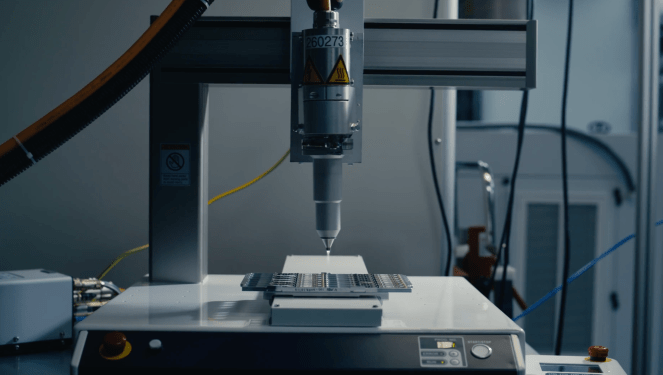
The company’s goal is to manufacture a thousand units per day within the year to qualify for bulk orders in 2027 and 2028. A significant challenge is implementing fully automated, lights-out manufacturing techniques, which are uncommon in U.S. industry but concentrated in China.
By co-locating design and production, Mesh hopes to create more efficient and lower-cost components. Their current design eliminates a commonly used but power-hungry part, which could reduce GPU cluster power usage by 3% to 5%. This is a meaningful saving for hyperscalers seeking maximum efficiency.
Mesh’s ambitions extend beyond data centers. The founders see optical wavelength communications as the next paradigm, aiming to move the world from a primary focus on radio frequencies to photonics. Their ultimate goal is to interconnect everything, starting with computers.
As Thrive Capital Partner Philip Clark noted, if AI is the most important technology in generations, relying on competitive countries for critical data center components is a problem. Mesh is working to solve the interconnect scaling needed for AI’s future.