
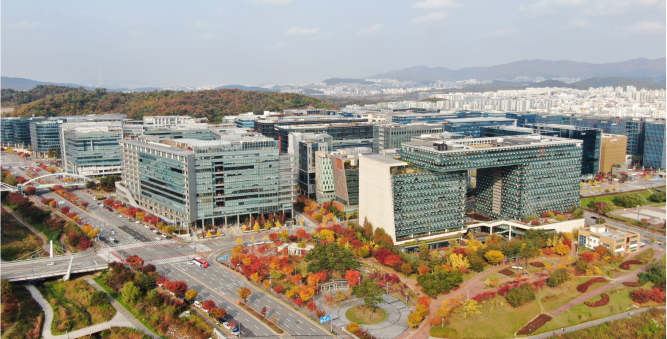
Just south of Seoul, in the city of Seongnam, lies what many call the Silicon Valley of South Korea. This is the sprawling tech complex known as Pangyo Techno Valley. It is only a fifteen-minute subway ride from Gangnam, the Seoul district famous for luxury boutiques, K-pop agencies, and neon nightlife.
Since its launch in 2011, the 661,000-square-meter development has grown into one of the country’s most significant innovation hubs. It is home to more than 1,800 startups, research centers, and global tech firms. The district feels more like a laboratory for South Korea’s future than a suburb of Seoul.
Big names are everywhere in Pangyo Techno Valley. These include Naver, often described as Korea’s Google, and Kakao, the country’s everything app. Gaming powerhouses Nexon and NCSoft anchor the district alongside industrial heavyweights like shipbuilder HD Hyundai and cybersecurity pioneer AhnLab. Samsung Electronics, semiconductor giant SK Hynix, and Hyundai’s autonomous vehicle division 42dot all maintain significant presences.
Despite this concentration of tech talent and capital, industry insiders question whether Pangyo truly deserves its Silicon Valley comparison. Hyoungchul Choi, CEO of Portologics, who founded his company there five years ago, acknowledges Pangyo is Korea’s most concentrated hub for software, gaming, platforms, and AI. But he is skeptical of the nickname. He notes that Silicon Valley is built on decades of international capital flows, a risk-taking culture, and a worldwide draw for talent, areas where Pangyo is not yet equivalent.
The statistics support this more modest assessment. According to Pangyo Techno Valley’s official website, as of a year ago approximately 91.5 percent of its companies were small and midsize businesses. Big Tech accounted for just 3.6 percent, with the remaining 4.9 percent made up of public or government organizations.
Janice Sa, a principal at Z Venture Capital, has been working in Pangyo for more than a decade. She sees the district’s influence waning. She says that with giants like Kakao, Naver, Nexon, and NCSoft in one place, the Silicon Valley title still makes sense. But compared to ten years ago, the district does not feel as dominant as the country’s go-to tech hub. She observes that while startups once flocked to Pangyo, many are now heading back to Gangnam in Seoul. The reasons boil down to talent and capital. Young developers and engineers gravitate toward Gangnam, and most venture capital firms are located along Teheran Street, the city’s main tech corridor. For hiring and fundraising, that makes Gangnam the easier choice.
This exodus reflects a broader challenge. For large corporations tied to long-term leases with tax incentives, being in Pangyo is not an issue. But for startups competing for talent, the location can be a greater challenge. Pangyo might be a short ride from Gangnam, but it is still in Gyeonggi Province, not Seoul. Because government support programs are often tied to local jurisdictions, Seoul ends up with more active startup infrastructure and stronger global initiatives.
An insider at a Pangyo-based tech firm shared a similar perspective. With so many tech companies in one place, Pangyo has developed a culture naturally geared toward the industry. Collaboration comes easier when everyone is just around the corner. However, Seoul is more diverse. For example, Yeouido is Korea’s Wall Street, perfect for fintechs, while Gangnam draws startups of every kind.
The bigger question is whether Korean startups, regardless of location, can compete globally. Both government and private investors are pushing companies to expand internationally as the domestic market saturates. Yet breakthrough success stories remain elusive.
A Kakao Ventures investor highlighted cultural differences that may explain the gap. American startups tend to succeed and fail much faster, which fuels constant experimentation and a high rate of talent movement. Speed is a startup’s greatest strength, so the investor tries to have open conversations with founders about how to turn failure into opportunity.
Storytelling is another challenge. The investor noted that many Korean founders are sharp on numbers and strategy but stumble on a simpler question: what is your story? Business is still about people connecting with people. Without a clear, authentic narrative of why a team is the right one for the task, it is hard to stand out. When so many founders already bring strong skills to the table, that personal story becomes even more important.
Despite the challenges, Choi sees reason for optimism. The scene blends the grit of scrappy founders with the steady influence of big Korean tech companies, where stability and benefits still matter. Unlike in the United States, where founders often leap into risk and pivot fast, startups in Korea tend to balance ambition with discipline. They build proof at home before going abroad, resulting in dependable engineering but without the same move fast, break things energy that defines Silicon Valley.
Choi also observed that Pangyo is moving beyond gaming and platforms into artificial intelligence, biotech, and deep tech, with governments investing in startup campuses and scaling programs.
The real test now is less about local growth and more about proving global success through unicorns, cross-border exits, and steady inflows of talent. Choi identified three key factors holding Korean startups back from going global: the small size of the home market, weaker ties to global investors, and language or regulatory hurdles that create additional friction. Breaking through takes more than ambition; it needs early global partners, deliberate go-to-market resources, and leaders who think cross-border from day one.
Yet a fourth factor, the ability to tell compelling stories to the world, may prove to be the biggest difference between remaining a regional tech hub and becoming a true global innovation center.