
Salesforce made a major effort to convince investors that the rise of artificial intelligence will not be its downfall when it announced fourth-quarter earnings. The company reported a solid quarter with revenue of $10.7 billion, an increase of 13 percent year-over-year. For the full year, revenue reached $41.5 billion, up 10 percent from the previous year. These results were boosted by its acquisition of the data management company Informatica last May.
Net income for the quarter was $7.46 billion. The company also provided strong guidance for the year ahead, projecting revenue between $45.8 billion and $46.2 billion, which would represent a 10 to 11 percent increase. Salesforce additionally reported that its remaining performance obligation, a measure of contracted revenue not yet delivered, stands at over $72 billion.
Despite these strong numbers, software-as-a-service stocks, with Salesforce as a prime example, have faced significant pressure. Investors fear that the rise of AI agents could undermine these companies by making their traditional per-employee business models obsolete. This trend has been dubbed the “SaaSpocalypse.”
The concept was so prevalent during the earnings call that CEO Marc Benioff mentioned the term at least six times. He addressed the fears directly, stating, “You’ve heard about the SaaSpocalypse? And it isn’t our first. We’ve had a few of them.” He later added, “If there is a SaaSpocalypse, it may be eaten by the Sasquatch because there are a lot of companies using a lot of SaaS because it just got better with agents.”
To demonstrate its health and confidence, Salesforce announced several financial moves. The company increased its dividend by nearly 6 percent to $0.44 per share and launched a new $50 billion share buyback program, a move typically favored by shareholders.
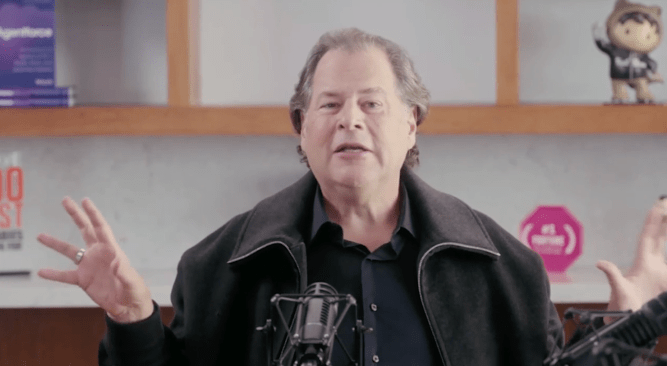
The company also revamped the format of its earnings call, blending elements of a podcast, infomercial, and traditional analyst Q&A. Instead of solely reviewing financial figures, Benioff conducted on-camera interviews with three Salesforce customers: the CEOs of SharkNinja, Wyndham Hotels and Resorts, and SaaStr. Each executive testified to the value of Salesforce’s new AI agent products.
Salesforce introduced a new metric for these products called agentic work units, or AWU. This metric aims to measure whether an AI agent successfully completes a specific task, such as writing to a record, rather than just processing tokens, which is the standard unit of AI volume. The company noted it processed 19 trillion tokens last quarter.
Furthermore, Salesforce presented its architectural vision for the future of AI agents. This vision positions SaaS software like Salesforce at the top of the technology stack, with AI model makers serving as interchangeable, commoditized engines at the bottom. This presentation served as a direct counter to a vision recently presented by OpenAI, which places its own technology at the center of the stack.
To cap off the presentation, CEO Marc Benioff appeared wearing a black leather jacket, echoing the signature style of Nvidia CEO Jensen Huang, a leader currently dominating the AI industry.