
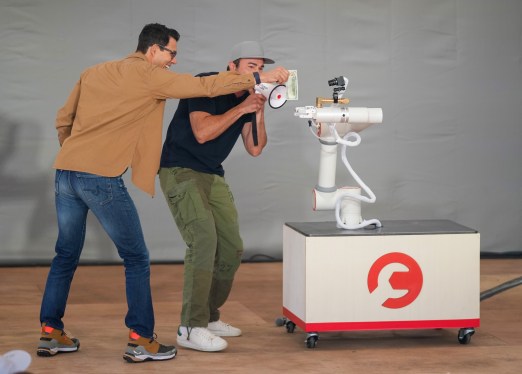
You may not have heard, but Rivian founder and CEO RJ Scaringe has launched another company, his third by our count. This time his focus is on robotics.
Scaringe is best known for Rivian, the electric vehicle maker that gained attention in 2018 after debuting an electric truck with its now-famous gear tunnel. The publicly traded company is now just a few months away from delivering its most important EV yet, a mid-sized SUV called the R2. This vehicle is cheaper to build than its flagship R1 counterpart, roughly half the cost according to Scaringe, and in many ways is more technologically capable. It will also be more affordable for buyers, with the first version starting at $57,990, which is 20% cheaper than the base R1T pickup.
Then there is Also, the micromobility startup that began as an internal project within Rivian and spun out last year with venture capital funding. Rivian maintains a minority stake in Also, which launched a pedal-assist modular electric bike and a cargo quad vehicle last October. Scaringe remains deeply involved with that startup as well.
Now, Scaringe has turned his attention to robotics. He has aptly named his new startup Mind Robotics, though that was not its original name. Mind Robotics was not born within Rivian, although the automaker may someday become a customer. It is a private company founded by Scaringe that recently raised a $500 million Series A round co-led by venture firms Accel and Andreessen Horowitz. The company, which has raised $615 million since its founding in November 2025, is now valued at about $2 billion.
Scaringe discussed his new ventures on the sidelines of South by Southwest, where his company is the primary sponsor. The following conversation focuses on robotics and how his new startup is taking a different approach.
When asked if he was done spinning off companies, Scaringe paused and said, “Three companies? Probably.” He confirmed, “Yeah. I mean, yeah.” He noted that Also is present at the event, which he finds cool, and he is happy to see the brands co-existing.
He explained that Mind Robotics is something he has been working on for a while. Also was unique because it was built within Rivian and then spun out. Mind, however, is a whole new company where Rivian is more like a partner. He is wildly bullish on it, believing it will benefit Rivian but also has the potential to be a very large business given the scale of the opportunity.
The idea for Mind originated about two years ago, linked to confidence in the R2 vehicle program. Anticipating high volume for the R2 meant planning for multiple new factories over the next decade, representing billions in capital expenditure. Scaringe initiated a study on the future of manufacturing, concluding that while classic industrial robotics would persist, robotics with human-like skills would become crucial.
He already had a strong thesis around AI in the physical world and met with many companies working on robotics capable of human-like skills. He broadly categorized them into existing industrial robotics companies, which would continue but not focus on human-like tasks, and a new batch of startups, many surprisingly focused on home applications like folding towels.
Scaringe came to the view that none of these companies had all the necessary ingredients for success. He felt he could build a better company, unwilling to base Rivian’s future manufacturing on companies that lacked experience in industrialization, understanding of industrial operations, a data flywheel for training models, or established supply chains.
He decided to start a new company, figured out the governing structure, raised a seed round on the day he launched it, and then completed the recent Series A financing.
When asked about the original project name, Scaringe revealed it was “Project Synapse.” The name Mind links to synapse and the brain. He was also inspired by his children’s school, which is named Synapse. He almost called the company Synapse but wanted something simpler.
The board of Mind Robotics includes Scaringe, Jiten Behl of Eclipse, Sameer from Accel, and a representative from Rivian. As a private company, Scaringe noted it is much easier to manage than a public one.
Regarding how Mind Robotics compares to companies like Boston Dynamics, Scaringe stated they are building the AI models, the robotics hardware, and the infrastructure for deployment at scale. He emphasized that many robotic systems designed for manufacturing are overly complex, often mimicking human biomechanics in unnecessary ways.
He argued that in an industrial setting, the work happens with the hands. The primary function of a robotic system is to get the hands to the right place. While demonstrating complex motions like backflips shows flexibility, such capabilities are unnecessary for most factory tasks and add complexity, failure modes, and power consumption.
Scaringe believes many humanoid systems for manufacturing are too complex. They will be human-like, with hands, a perception model, and locomotion, but strictly mimicking human biomechanics misses the point that manufacturing work is hand-based.
He explained that the hands are the most complicated part and where the focus, energy, and spending should go. Different industrial tasks require different gripping solutions, from handling large steel pipes to threading small fasteners.
He drew an analogy to evolution in the biological world, where optimal biomechanics differ for swimming, running, or climbing. Assuming the human form is optimal for all factory work ignores that humans did not evolve in a plant. However, factories have evolved around humans, meaning robots must fit into human spaces and use their hands.
The operational domain in a factory is friendlier than a home. Robots do not need to navigate stairs, carpet transitions, or avoid pets and children. The environment is mapped and largely static, though interaction with humans is important, making the user interface critical.
Scaringe said the robot needs to feel friendly because it will work alongside humans for long periods, but not so dopey that it gets a “kick me” sticker on its back. He observed that many robots have lean, muscular, Terminator-like forms, likely influenced by science fiction. He believes there is a different, more approachable form factor that can still be capable without being intimidating.
He sees a thread connecting his thinking at Also, with its modularity, and now at Mind. He also referenced Rivian, noting that in 2018, no one would have pictured a 1,000-horsepower truck looking like the R1. The idea is that high capability does not have to look intimidating or scary; it can be friendly. This design belief and aesthetic will carry into robotics as well.