
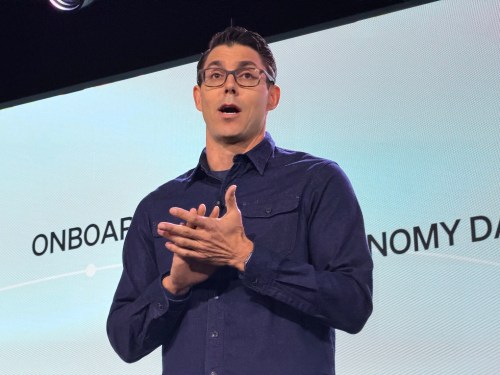
A robot swerved through the cafeteria of Rivian’s Palo Alto office, its shelves adorned with chilled canned coffees, until it abruptly stopped. Five minutes later, a man carefully pushed it out of the way, the words “I’m stuck” flashing yellow on the droid’s screen. It was an inauspicious start to Rivian’s “Autonomy & AI Day,” a showcase for the company’s plans to make its vehicles drive themselves. Rivian does not make that cafeteria robot, but there was a familiar message in its failure: this technology is hard.
Hours later, during a 15-minute demo of Rivian’s new “Large Driving Model” in a 2025 R1S SUV, I was reminded of that message. The electric vehicle, equipped with the automated-driving software, carried myself and two Rivian employees on a switchback route near the company’s campus. As we glided past Tesla’s engineering office, I noticed a Model S in front of us slow to turn into the rival company’s lot. The R1S eventually noticed this too, braking hard just before the Rivian employee nearly intervened.
There was one actual disengagement during my demo. The employee in the driver’s seat took over as we passed through a one-lane section of road blocked by tree-trimming equipment. It was minor overall, but not exactly rare; I observed multiple other demo rides that also had disengagements.
The rest of the drive went well enough for software that is not ready to be shipped, especially considering Rivian threw out its old rules-based driver assistance system and adopted an end-to-end approach, similar to how Tesla developed its Full Self-Driving system. It stopped at stoplights, handled turns, and slowed for speed bumps all without programmed rules telling it to do these things.
Rivian’s old system was all very deterministic and structured. Everything the vehicle did was the result of a prescribed control strategy written by humans, said CEO RJ Scaringe. He explained that when Rivian saw transformer-based artificial intelligence taking off in 2021, he quietly reconstituted the team and started with a clean sheet to design a self-driving platform for an AI-centric world.
After extensive development, Rivian launched the new ground-up driving software in 2024 on its second-generation R1 vehicles, which use Nvidia’s Orin processors. Scaringe said it was only recently that his company started to see dramatic progress once the data started really pouring in.
Rivian is betting it can train its Large Driving Model on fleet data so quickly that it will allow the company to roll out “Universal Hands-Free” driving in early 2026. This means Rivian owners will be able to take their hands off the wheel on 3.5 million miles of roads in the U.S. and Canada, so long as there are visible painted lines. In the back half of 2026, Rivian will enable “point-to-point” driving, which is the consumer version of the demo ride.
By the end of 2026, after Rivian has started shipping its smaller, more affordable R2 SUVs, it will ditch the Nvidia chips and outfit those vehicles with a new custom autonomy computer unveiled at the event. That computer, plus a lidar sensor, will eventually allow drivers to take their hands and eyes off the road. True autonomy, where a driver does not have to worry about retaking control, lies well beyond that and will largely depend on how fast Rivian can train its model.
This rollout introduces a near-term challenge. The new autonomy computer and lidar will not be ready until months after the R2 goes on sale. Customers who want a vehicle capable of eyes-off driving will have to wait. The R2 is a crucial product for Rivian, especially following declining sales of its first-generation vehicles.
Scaringe acknowledged that when technology is moving this fast, there is always some level of obsolescence. He stated the company wants to be direct about what is coming. The early R2s will still get Rivian’s promised point-to-point driving, which will be hands-off but not eyes-off. He believes some customers will wait for the more capable version, while others will buy the R2 immediately and potentially trade it in later. He noted there is significant demand backlog for the R2, and by being upfront, customers can decide for themselves.
In a perfect world, everything would launch simultaneously, but the timeline of the vehicle and the autonomy platform are not perfectly aligned, Scaringe said.
When I first interviewed Scaringe in 2018, before Rivian had even revealed its vehicles, he shared a goal that has stayed with me. He wanted to make Rivian’s vehicles so capable that if you went for a hike starting at one point and finishing at another, the vehicle would meet you at the end of the trail. It was the kind of ambitious promise about self-driving cars that was common seven years ago.
Scaringe told me he still believes it is possible for Rivian to enable a use case like that in the next few years. It will not happen until the company builds and tests its more-capable R2 vehicles, which is at least a year away in a best-case scenario. He said that while it has not been a huge focus, it could change as the company gets closer to level 4 autonomy, when its model will be trained on trickier roads without features like lane lines.
Then, it becomes a question of the operational domain. Dirt roads and off-road could be easy, he said. But do not expect a Rivian driving itself up a challenging trail like Hell’s Gate in Moab. The company is not putting any resources into autonomous rock crawling. But in terms of getting to the trailhead autonomously? For sure.