
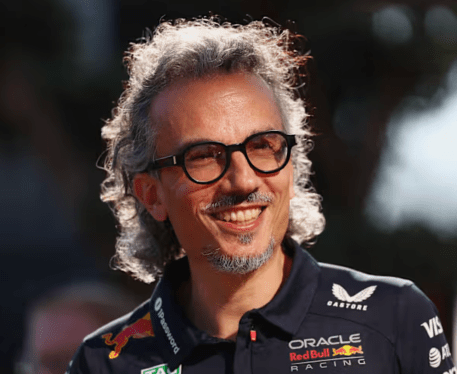
There is a revealing moment backstage at Web Summit when a member of the production crew, easily twice the size of Laurent Mekies, wraps a beefy arm around the Oracle Red Bull Racing CEO’s shoulder to steer him toward the soundboard for a selfie. Most executives leading a two-thousand-person organization would bristle at such informality, even from a superfan. Mekies instead smiles, his demeanor unchanged as he accommodates the starstruck crew member.
It is a small moment but perhaps a telling one about Mekies, who just four months ago became only the second person to lead Red Bull Racing in its twenty-year history. The first feeling is one of being privileged and honored to suddenly be part of such an incredible team, Mekies later said onstage. This team has been winning more than anyone else in Formula One in the last two decades, and then suddenly you are part of it.
Suddenly is not an overstatement. As widely reported, the wholly unexpected call came in July. Christian Horner, the outspoken executive who had led Red Bull since its entry into Formula One in 2005, was out. Mekies, who had been running the team’s sister outfit, Racing Bulls, for just over a year, was tapped to step up.
Mekies was an improbable choice in some ways. Where Horner delights in the media spotlight and gamesmanship that defines Formula One team principals, Mekies spent much of his career in the engineering trenches. His approach to winning reflects that technical background. He sees performance gains not just in aerodynamics and tire compounds, but in eliminating friction from workflows and processes.
That philosophy extends to the team’s partnerships. Consider the cybersecurity company whose CEO sat beside Mekies on the Web Summit stage. The partnership between a cybersecurity company and a Formula One team might seem like an odd fit. Security usually means friction, like passwords to check and systems to authenticate, which slow people down. In Formula One, where thousandths of a second matter, that is unacceptable.
But that is exactly why Mekies sees the partnership as integral to Red Bull’s competitive edge. Their people have to manage and log in and out of complex systems for aerodynamics, vehicle dynamics at the track, back at the factory, at the simulator, and in the wind tunnel. He stated that they now go faster in this seamless login and logout process for their people from one system to another than what they were doing without the security level.
It is a small competitive advantage, but in Formula One, small advantages compound. You are looking after the tiniest competitive advantage, one after the other, Mekies noted. Their tech geniuses and people challenge them every day about the noise that is somewhat unavoidable for a large team. With this solution, they reduce the noise, increase the time for the core business, and that is fundamentally where the performance comes from.
At forty-eight, Mekies has seen Formula One from nearly every angle. After studying at an engineering school in Paris and Loughborough University in the United Kingdom, he started in Formula Three in 2000 before crossing into Formula One with a British racing team called Arrows in 2001. He then joined Minardi, an Italian team, in 2003 as a race engineer. When Red Bull bought the struggling outfit and transformed it into Toro Rosso in 2006, with the idea to create a junior team to develop young drivers for Red Bull Racing, Mekies was promoted to chief engineer.
Mekies stayed for eight years before moving on to become safety director at the Fédération Internationale de l’Automobile, the rulemaker for Formula One and other motorsport series worldwide. There, he reportedly championed the titanium safety device mounted above the cockpit of Formula One cars to protect the driver’s head, known as the halo system. Then it was on to Ferrari as deputy race director, and five years later, back to Red Bull’s junior racing team, which was renamed Racing Bulls in 2024.
Mekies brings a breadth of experience to the role. What he does not bring, not yet at least, is a lot of ego. When his star driver won the Italian Grand Prix in what became the fastest race in Formula One history, reporters asked Mekies about his contribution to the victory. His answer was self-effacing, stating he had zero contribution. When the reporters laughed, he insisted he was not kidding.
When asked about that moment on stage at Web Summit, Mekies shrugged. He said all they do as leaders is put their people in position to be able to express their talents, so it is very much their win.
Mekies sees his role differently than his high-profile predecessor. He is not deliberately trying to lead from behind. Instead, he said that he does not think the approach matters, nor does he think it is about leadership style. You will find every possible style in leadership. He believes what matters in leadership is care for the people and a care-for-the-company culture.
While Mekies could certainly shower attention on his star driver, he is more focused on the collective. Your first thoughts are for the two thousand people back in the factories who have never given up on this season, he says. It takes a tremendous amount of energy and company culture to keep that motivation and that fighting spirit.
Humility does not mean playing it safe. The Monza win also validated a somewhat surprising decision to keep pushing on the current car rather than abandoning it for next year’s development. They were not happy about where the car performance had been at the beginning of the year and up until the middle of the year, Mekies explained. They decided to press on a bit more with the current car. They did not feel that they could simply turn the page and have wishful thinking about how everything would be better next year.
It was a risky call. With completely new regulations coming in 2026, most teams had already shifted resources to next year’s car. But Mekies felt his team needed to understand what had gone wrong before they could move forward. They felt they had to get to the bottom of what had not been working. He said they perhaps pushed a bit more than some of the competition, and luckily, it gave them this turnaround in form. Now the team heads into winter with less development time than its rivals, but with a lot more trust in their tools, methodologies, and process.
If Mekies’ current year turnaround was risky, the next year represents something else, a crazy adventure as Mekies describes how Red Bull is building its own power unit for the first time, in partnership with Ford. For Oracle Red Bull Racing, there are no other words to describe next year other than as a crazy challenge. That is how big it is for them.
For a sense of what the team is taking on, Mekies described it on stage. They are going to do their own power unit with the support from Ford and compete against people that have been manufacturing Formula One engines for more than ninety years. He called it the sort of crazy level that only Red Bull can do. They decided to create overnight facilities in the middle of a field in Milton Keynes in the United Kingdom from zero, getting the building, getting the dynos in, hiring six hundred people, trying to get them to work together, and eventually trying to get an engine up to speed to reach the track.
When asked if he can promise his star driver a championship-winning car next year, Mekies answered straightaway. They would be silly to think that they just go in there and are going to be at the right level straight away. He said that is not going to happen. But they take it the Red Bull way, with all the high-risk, high-gain approach that they cherish.
He has reason for optimism. Sitting third in this year’s Formula One team standings, just behind Mercedes, Red Bull has a realistic shot at overtaking them for second place in the final three races of this year’s season. It is a far cry from the dominance Red Bull enjoyed in recent years, but given how the season started, it would represent a major recovery.
Backstage before their conversation, as makeup artists powdered them for the stage lights, Mekies was asked about the pressure of those final races. His answer was typically methodical. He said they always say that they take it race by race, so that is what they are going to do in the next three races. You want to turn up at the racetrack and put the car in the right window, meaning the narrow range of conditions where a car performs optimally, and fight for the win.
He said it is incredibly difficult to fight at that level, but everyone in Milton Keynes has been doing such a tremendous job to turn the car around and to give them a competitive package for the end of the season. In the meantime, he insists that he is not looking at the points tables or the what-ifs. They do not look at the numbers. They know there is a lot happening in the standings, but they only look at it race by race. That is the only thing they do, he says, describing Red Bull’s mission as chasing lap times.