
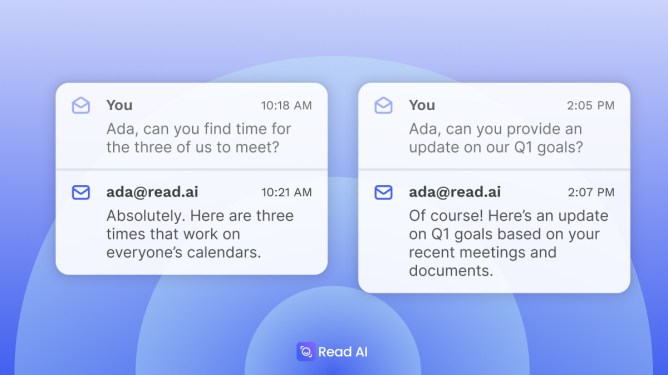
On Thursday, the meeting notetaker company Read AI launched an AI-powered email-based assistant called Ada. This new tool helps users manage their schedules, answer questions based on a company’s knowledge base, and reply to out-of-office emails.
The company describes Ada as a “digital twin” that handles tasks for you around the clock. It will be available to all users, who can begin configuring it by sending an email to “ada@read.ai” with the message “Get me started.”
When you ask Ada to find a meeting time with someone, it replies to the other person in the email thread with your availability. If that person suggests a different time, Ada responds with new options. While Ada accesses your calendar through Read AI, it does not reveal the details of your meetings to others.
Ada can also answer questions by drawing from a company’s knowledge base, topics from your prior meetings, and public internet searches. For example, you could ask, “Ada, can you provide an update on how we are tracking for Q1 goals?” to get relevant information.
If someone asks a question in a thread, Ada will prepare a response for you to review and refine before sending. The startup emphasized that Ada does not reveal sensitive information without your permission.
Read AI’s VP of Product, Justin Farris, explained that this feature does not rely on model context protocols. Instead, it builds a knowledge graph from meeting data and connected services to provide more contextual answers. He added that over time, Ada will take proactive actions. For instance, if you mention a follow-up item in a meeting, Ada will later prompt you to set it up with relevant context.
CEO David Shim told TechCrunch that adding Ada to your workflow is like training a new employee. As you connect more services to provide context, Ada ramps up and handles more tasks for you.
The company stated that while Ada currently works via email, it will soon be available on Slack and Microsoft Teams.
On the sidelines of Web Summit Qatar earlier this month, Shim shared that Read AI now has over 5 million monthly active users and aims to grow that number to 10 million. He mentioned the company sees 50,000 sign-ups daily and has a broader base of 100,000 users who consume content like meeting summaries without an account.
For Read AI, the United States remains the largest market, but the company is experiencing strong international growth. While 60% of users are outside the U.S., revenue is split roughly equally.
The company, which has raised over $81 million in funding, continues to add AI-powered tools. Last year, it launched Search Copilot for knowledge discovery. Last month, it added features to update customer-service software, send custom emails from meeting reports, and stay updated on topics using internal and web knowledge.
Other meeting notetakers are also introducing new tools. Last September, Granola added repeatable prompts called “recipes” to surface knowledge from meeting data. Quill, which recently came out of stealth with a $6.5 million funding round, connects to tools like Linear, Notion, and CRMs to automate tasks.