
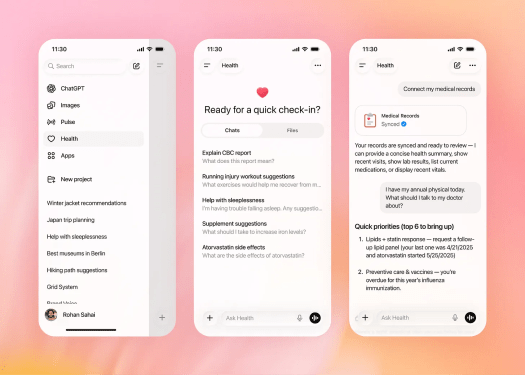
OpenAI announced ChatGPT Health on Wednesday. The company stated this new feature will provide a dedicated space for users to discuss their health with ChatGPT.
People already frequently turn to ChatGPT for medical inquiries. OpenAI reports that over 230 million health and wellness questions are asked on the platform each week. The new ChatGPT Health product will separate these conversations from other chats. This ensures the context of your health discussions does not appear in standard conversations with the AI.
If users begin discussing health topics outside of the dedicated Health section, the AI will aim to guide them to switch over. Within the Health section, the AI may reference information from standard conversations. For example, if you previously asked ChatGPT for help building a marathon training plan, the AI would know you are a runner when you later discuss fitness goals within Health.
ChatGPT Health will also integrate personal information or medical records from connected wellness apps such as Apple Health, Function, and MyFitnessPal. OpenAI explicitly notes that it will not use conversations from the Health section to train its AI models.
Fidji Simo, the CEO of Applications at OpenAI, wrote that she views ChatGPT Health as a response to existing challenges in healthcare. These include high costs, access barriers, overbooked doctors, and a lack of continuity in care.
However, while the healthcare system has drawbacks, using AI chatbots for medical advice introduces its own set of challenges. Large language models like ChatGPT operate by predicting the most likely response to a prompt, not by determining the most correct answer, as they lack a concept of truth. AI models are also known to be prone to generating incorrect or fabricated information, known as hallucinations.
OpenAI’s own terms of service clarify that its technology is not intended for use in diagnosing or treating any health condition. The ChatGPT Health feature is expected to roll out in the coming weeks.