
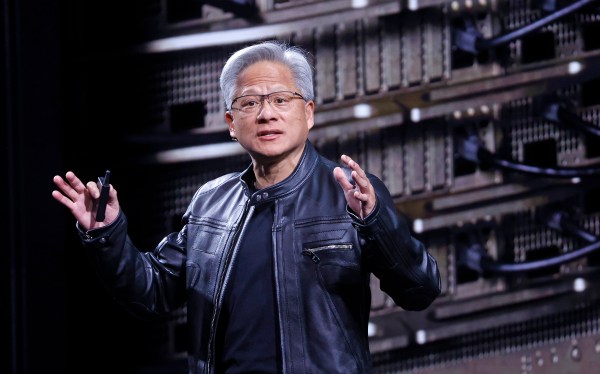
Chip giant Nvidia, the world’s most valuable company, reported record profits in its most recent quarter on Wednesday. This surge is driven by skyrocketing demand for AI computing power. CEO Jensen Huang emphasized the scale of this demand on a call with analysts, stating, “The demand for tokens in the world has gone completely exponential. I think we’re all seeing that, to the point where even our six-year-old GPUs in the cloud are completely consumed and the pricing is going up.”
The company reported $68 billion in revenue for the quarter, a 73% increase from the prior year. The vast majority of this, $62 billion, came from its data center business. Notably, Nvidia divided that data center revenue into $51 billion from compute products, largely GPUs, and $11 billion from networking products like NVLink. For the full fiscal year, the company reported $215 billion in revenue.
As in previous quarters, Nvidia did not report any revenue from chip exports to China, despite recent U.S. government actions to lift some export restrictions. Chief Financial Officer Colette Kress explained, “While small amounts of H200 products for China-based customers were approved by the U.S. government, they have yet to generate any revenue, and we do not know whether any imports will be allowed into China.”
Kress also addressed growing competition, noting, “Our competitors in China, bolstered by recent IPOs, are making progress and have the potential to disrupt the structure of the global AI industry over the long term.” This appears to reference companies like Moore Threads, which had an IPO in December.
During the investor call, Huang addressed the company’s pending investment in OpenAI, which has been reported at $30 billion. “We continue to work with OpenAI toward a partnership agreement. We believe we are close,” Huang said. He also referenced partnerships with Anthropic, Meta, and Elon Musk’s xAI. However, statements Nvidia filed with the U.S. Securities and Exchange Commission on Wednesday emphasized that there was “no assurance” an investment would ultimately take place.
Huang also responded to concerns about the sustainability of major tech companies’ capital expenditure commitments on AI infrastructure. He argued that these compute investments are directly tied to future revenue. “In this new world of AI, compute is revenue. Without compute, there’s no way to generate tokens. Without tokens, there’s no way to grow revenues,” Huang said. “We’ve reached the inflection point and we’re generating profitable tokens that are productive for customers and profitable for the cloud service providers.”