
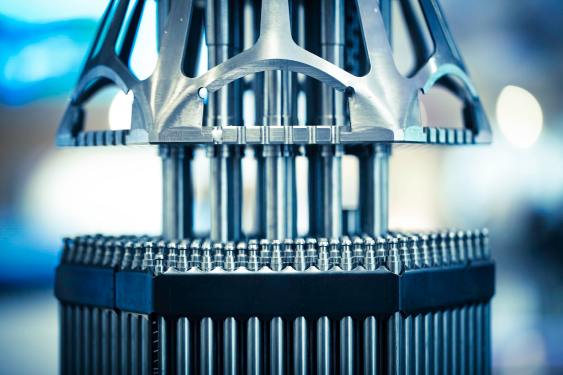
The nuclear industry is in the midst of a renaissance. Old plants are being refurbished, and investors are showering startups with cash. In the last several weeks of 2025 alone, nuclear startups raised $1.1 billion, largely on investor optimism that smaller nuclear reactors will succeed where the broader industry has recently stumbled.
Traditional nuclear reactors are massive pieces of infrastructure. The newest reactors built in the U.S., Vogtle 3 and 4 in Georgia, contain tens of thousands of tons of concrete, are powered by fuel assemblies 14 feet tall, and generate over 1 gigawatt of electricity each. But they were also eight years late and more than $20 billion over budget.
The fresh crop of nuclear startups hopes that by shrinking the reactor, they will be able to sidestep both problems. Need more power? Just add more reactors. Smaller reactors, they argue, can be built using mass production techniques, and as companies produce more parts, they should get better at making them, which should drive down costs.
The magnitude of that benefit is something experts are still researching, but today’s nuclear startups are depending on it being greater than zero. However, manufacturing is not easy. Just look at Tesla’s experience. The company struggled mightily to profitably produce the Model 3 in large numbers, and it had the benefit of being in the automotive industry, where the U.S. still has significant expertise. U.S. nuclear startups do not have that advantage.
Milo Werner, a general partner at DCVC, explained the challenge. She has friends in nuclear supply chain roles who can list five to ten materials that are no longer made in the United States. The country has forgotten how to make them and must buy them overseas.
Werner knows about manufacturing from her previous work at Tesla and FitBit, where she led new product introduction and factory launches. Today, she also co-founded the NextGen Industry Group to advance new technologies in manufacturing.
She points out that when companies want to manufacture something, they face two main challenges. The first is capital, which is often the biggest constraint since factories are not cheap. Fortunately for the nuclear industry, that should not pose much of a problem right now, as they are awash in capital.
But the nuclear industry is not immune from the second challenge all manufacturers face, which is a lack of human capital. The United States has not built many industrial facilities in 40 years, and as a result, it has lost the muscle memory. Werner compares it to sitting on the couch for ten years and then trying to run a marathon the next day.
After decades of offshoring, the U.S. lacks people experienced with both factory construction and operations. This shortage is not just for machine operators, but for everyone from factory floor supervisors all the way up to CFOs and board members.
The good news is that Werner sees many startups, nuclear and otherwise, building early versions of their products close to their technical teams. This proximity pulls manufacturing closer to the United States and allows for a faster cycle of improvement.
To reap the benefits of mass manufacturing, it is helpful for startups to start small and scale up. Werner notes that leaning into modularity is very important for investors. A modular approach lets companies start producing small volumes early to collect data on the manufacturing process. Ideally, that data shows improvement over time, which can reassure investors.
The benefits of mass manufacturing do not happen overnight. Companies often forecast cost reductions from learning through manufacturing, but it might take longer than they expect. Often it takes years, even a decade, to get there.