
Flora, a design tool used by designers at companies like Alibaba, Brex, Pentagram, and Lionsgate, has reached a new milestone. The startup announced on Tuesday that it has raised forty-two million dollars in a Series A funding round led by Redpoint Ventures.
Generative AI models are increasingly used in design through prompts and other multimodal inputs. Major software companies like Adobe, Figma, and Canva have integrated AI features more deeply into their products. At the same time, newer design startups believe that harnessing AI and testing different models requires entirely new workflows and interfaces.
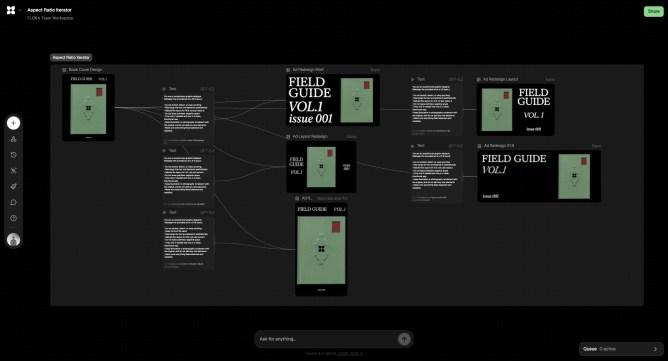
To address these evolving needs, Flora allows customers to use image, text, or video to create media assets. Users can employ prompts to make modifications and build new nodes with multiple iterations. All these generated versions are mapped together on a canvas, providing a clear and tractable flow of creation.
Users can branch out from any node to create a new version of their concept. For example, someone creating a marketing video can provide reference images and text prompts to establish a concept. They can then apply different prompts to generate videos in contrasting styles to compare results.
Flora’s CEO and founder, Weber Wong, was previously an investor at Menlo Ventures before joining New York University’s Interactive Telecommunications Program, which blends technology and art. The alpha version of Flora launched in 2024 as part of that course, with a more stable version released last year.
Wong stated that he saw an opportunity to create a new interface that stitches different AI models together into a complete workflow on a single screen. He explained that while the personal computing paradigm led to tools like Adobe for controlling individual pixels, generative models can create entire pieces of media. This shift opens a creative opportunity to design the entire workflow.
He noted that node-based creation has traditionally been complex, but integrating AI allows designers to rapidly explore multiple iterations and ideas. With Flora, users can create media or concepts using text, image, or video inputs.
The rise of generative models has made AI-first startups highly sought after. Recent industry movements include OpenAI acquiring Sequoia-backed Visual Electric and Figma acquiring the node-based editor Weavy. Separately, Krea, another node-based editor, raised eighty-three million dollars in April.
Wong observed that the launch of such tools creates an overlap between professionals and new AI users, leading more people to use apps like Flora for design and ideation. However, he believes that for these tools to gain wider popularity, user education must improve. To that end, Flora deploys creatives to work with organizations and help them use the tool more effectively.
While the startup’s focus leans toward creatives, the tool is designed to be accessible for business owners or individual users. Flora’s plans start at sixteen dollars per month when paid annually, with scaled pricing for agencies and enterprises.
The company plans to use its new funding to scale its enterprise sales capabilities and increase marketing efforts. On the product side, it aims to build better creative controls and add traditional editing capabilities so professionals can complete projects without switching to another tool. Flora currently has twenty-five employees and may double or triple that headcount by year’s end.
Alex Brad of Redpoint Ventures said the firm was impressed by the product’s elegant design and ease of use. He expressed excitement about Flora democratizing design and bringing more people into the creative process, similar to Figma’s impact on product design. Brad added that Flora has the potential to impact creative processes in broader industries like fashion, advertising, photography, and branding.
The Series A round also included participation from Vercel CEO Guillermo Rauch, Twitch founder Justin Kan, Frame.io CEO Emery Wells, Hanabi Capital’s GP Mike Volpi, Menlo Ventures, a16z Games, Fal co-founders Gorkem Yurtseven, Burkay Gur, and Batuhan Taskaya, Long Journey Ventures, Cyan Banister, Factorial Capital’s managing partner Matt Hartman, and MSCHF founder Gabe Whaley. With this raise, Flora’s total funding to date has reached fifty-two million dollars.