
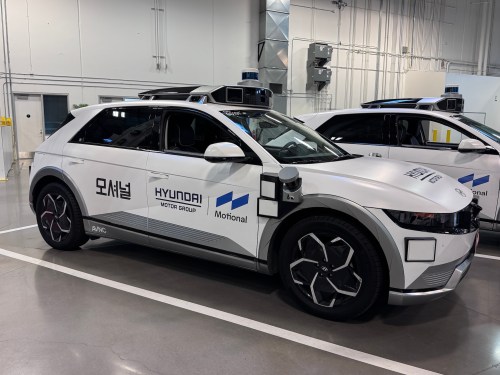
Nearly two years ago, Motional faced a critical turning point. The autonomous vehicle company, formed from a four-billion-dollar joint venture between Hyundai Motor Group and Aptiv, had already missed its target to launch a driverless robotaxi service with Lyft. Aptiv had withdrawn its financial backing, leading Hyundai to provide an additional one-billion-dollar investment to sustain operations. A series of layoffs, including a restructuring cut of forty percent in May 2024, reduced the workforce from a peak of roughly 1,400 employees to fewer than 600. With rapid advancements in artificial intelligence reshaping the industry, Motional confronted a stark choice: evolve or cease to exist. The company chose to evolve, pausing all commercial activities to reinvent its approach.
Motional has now rebooted its robotaxi strategy with an AI-first focus for its self-driving system. It has committed to launching a commercial driverless service in Las Vegas by the end of 2026. The company has already initiated a robotaxi service for its employees, which includes a human safety operator behind the wheel. It plans to offer this service to the public through an unnamed ride-hailing partner later this year. By the end of the year, the company aims to remove the human safety operator entirely, marking the start of a true commercial driverless operation.
Company leadership explained the strategic shift. They recognized the tremendous potential of recent AI advancements and acknowledged a gap in their previous system. While it was safe and driverless, it was not an affordable solution capable of scaling globally. This led to the difficult decision to pause commercial activities in the short term to accelerate long-term progress.
This meant moving from a classic robotics methodology to one centered on AI foundation models. Motional’s original self-driving system used individual machine learning models for tasks like perception and reasoning, combined with rules-based programming for other operations. This created a complex software web. Meanwhile, AI models initially designed for language began to be applied to physical systems like autonomous vehicles. The transformer architecture behind these models enabled more powerful and complex AI, paving the way for technologies like ChatGPT.
Motional sought to consolidate its many smaller models into a single, integrated backbone, creating an end-to-end architecture. It retained the smaller models for developer use, aiming for the best of both worlds. This approach is critical for generalizing to new cities and scenarios efficiently and for optimizing costs. For instance, adapting to different traffic lights in a new city would require only data collection and model training, not a full redevelopment.
A recent demonstration in Las Vegas offered a glimpse of this new approach. While a single ride cannot fully assess a self-driving system, it can highlight progress and differences. During a thirty-minute autonomous drive, the vehicle navigated off the busy Las Vegas Boulevard and into the congested pickup area of the Aria Hotel. It slowly maneuvered around a stopped taxi, changed lanes, and passed numerous pedestrians and obstacles—a scenario previously handled by a human driver in earlier operations.
More progress is still needed. The in-vehicle display graphics are under development, and during the demo, the vehicle hesitated while navigating around a double-parked delivery van, though no human disengagement occurred. Despite this, leadership asserts the company is on the right path for safe and cost-effective deployment, with Hyundai committed for the long term.
The ultimate vision extends beyond robotaxis. The goal is to eventually integrate Level 4 automation, which requires no human intervention, into personal vehicles. Robotaxis are the first major step, but the long-term aspiration is for any automaker to incorporate this technology into their cars.