
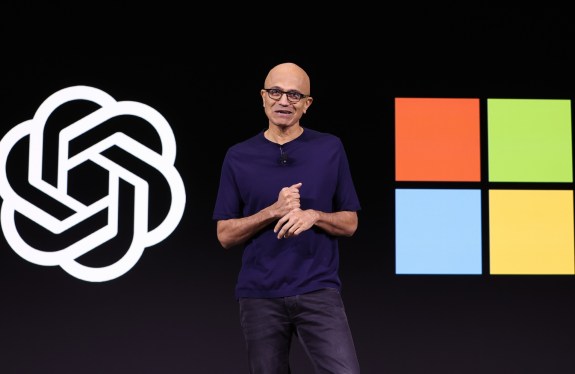
Microsoft and OpenAI may have a notoriously rocky relationship, but as OpenAI experiences never-before-seen revenue growth, Microsoft, one of its major investors, is benefiting greatly. When the software giant reported its latest quarterly earnings on Wednesday, it revealed a significant detail: its net income increased by $7.6 billion from its investment in OpenAI.
OpenAI reportedly has a 20% revenue share agreement with Microsoft, though neither company has ever publicly confirmed that. The software giant has invested more than $13 billion in the AI lab, which is currently looking to raise additional funding at a valuation between $750 billion and $830 billion.
In September, Microsoft and OpenAI renegotiated some terms of their deal when OpenAI restructured into a public benefit corporation. As part of that agreement, OpenAI committed to buying another $250 billion of Azure services. That commitment appears on Microsoft’s books as “commercial remaining performance obligations,” which are contracts that have not yet been paid out. Those obligations leaped to $625 billion from $392 billion in the previous quarter, with Microsoft stating that 45% of that is from OpenAI.
Anthropic also received a mention in the quarterly earnings for helping boost Microsoft’s anticipated future revenue. Commercial bookings grew 230%. In November, Microsoft announced a $5 billion investment into Anthropic, and the AI lab had signed up for $30 billion of Azure compute capacity, with intent to buy more later.
However, Microsoft is also spending heavily to fuel its AI ambitions. It spent $37.5 billion in the quarter on capital expenditures, two-thirds of which were for what Microsoft called “short-lived” assets, primarily the GPUs and CPUs for its cloud Azure to serve AI.
The company reported $81.3 billion in revenue, up 17% over the year-ago period and beating Wall Street expectations. Its Microsoft Cloud revenue hit $50 billion this quarter for the first time. All of Microsoft’s business units increased by double-digit percentages over the year-ago quarter, with the exception of Windows devices, which gained 1%, and Xbox content and services, which were down 5%.