
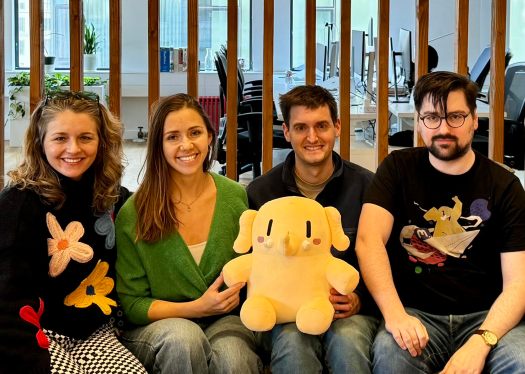
Mastodon’s creator, Eugen Rochko, is stepping down as CEO of the open source, decentralized social network and X rival. This change is part of the organization’s transition to a non-profit structure, which was announced at the beginning of the year. The change is Mastodon’s most significant leadership overhaul to date, and one designed to ensure Mastodon’s longevity.
As part of the restructuring, Mastodon will be governed by a board of directors. The board today includes Twitter co-founder Biz Stone, Karien Bezuidenhout, Esra’a Al Shafei, Mastodon Community Director Hannah Aubry, who will be stepping down, and Felix Hlatky, who will be taking the role of Executive Director.
With this revamp, Mastodon has the potential to expand its business, product, and mission without being dependent on a single person’s leadership. It will also give Rochko a break, as he has been singularly focused on Mastodon for the past ten years. Going forward, Rochko will continue contributing to Mastodon as an advisor. Rochko has also been compensated with a one-time payment of one million euros, given that he took less than a fair market salary over the years while building Mastodon.
Other members of the new leadership team include Renaud Chaput as Technical Director, Andy Piper as Head of Communications, and Philip Schröpel as Strategy and Product Advisor. In total, Mastodon has ten full-time employees.
Rochko said burnout was a factor in his decision. He knew it was time to step aside as Mastodon had grown to be bigger than he could manage alone. Rochko explained that Mastodon had become synonymous with his identity, leading to a lot of stress and ultimately burnout. He believes that taking a step back will allow him to restore some balance in his life. He also suggested others should do the same if they are able, stating that investing all of your time in work is not healthy. That message stands in contradiction to the new work-till-you-drop ethos that has infused Silicon Valley in the AI era, where founders are embracing hustle culture and even China’s intense nine nine six work schedule.
As a non-profit, Mastodon will be able to unlock new funding opportunities, particularly in Europe, noted the new Executive Director, Felix Hlatky. The organization has already transitioned to a non-profit in the U.S. but is still working to set up a nonprofit in Belgium to replace the German entity, which lost its non-profit status last year. Once established, the Belgian nonprofit will be the future home of the organization.
To aid in the transition, Mastodon raised funds from Stack Exchange founder Jeff Atwood and the Atwood family, who gave two point two million euros; Biz Stone; the alternative app marketplace AltStore, which gave two hundred sixty thousand euros; the Global Chinese Community of Universal Digital Commons, which gave sixty-five thousand euros; and Craigslist founder Craig Newmark.
Hlatky, who has a business and finance background in tech, had been consulting pro bono for Mastodon ahead of this transition. He says he had become disenchanted with the typical startup system involving venture capital, finding that it only works for outliers and he no longer saw meaning in contributing to that system. In his new position, Hlatky will engage in more conversations with industry stakeholders and the media, and sees the opportunity to have politicians, political parties, and journalists engage more on the platform. He will also help oversee projects to make Mastodon more financially sustainable, including its new hosting and moderation business. Other members of the leadership team will focus on trust and safety issues, technical infrastructure, and product.
One thing Mastodon will not be focusing on is any sort of native interoperability between its platform, powered by the ActivityPub protocol, and other decentralized social networks like Bluesky or those running on other protocols. Instead, Mastodon will leave interoperability to the makers of third-party projects. These different protocols are essentially competing technical standards for how decentralized social networks communicate.
By restructuring, Rochko believes Mastodon will maintain its position as billionaire-proof social media. That mission statement has also been adopted by Bluesky, a network that has grown larger than Mastodon with forty million registered users compared with Mastodon’s ten million. On both networks, a smaller number of those users are active on a monthly basis. On Mastodon, monthly active users have since dropped to under one million after a spike in 2022 that followed Elon Musk’s acquisition of Twitter. Before the deal closed, Mastodon had only around two hundred thousand monthly active users; after, it jumped to two million.
Rochko believes that indicates demand for a platform not controlled by a billionaire. He noted that Threads, Instagram, and Facebook belong to a billionaire, and X belongs to a billionaire. He stated that these platforms are increasingly used to steer public perception, public conversation, and politics. Rochko said that Mastodon is one of the very few, if not the only, social media platforms and the fediverse as a whole that is not subject to something like that.