
There has been a lot of talk around building context for AI systems. In consumer software, we have seen startups being built around search, documents, and meetings. All of them aim to capture context from your digital life, provide connections to other tools, and let you query all that data.
Some tools went further. For instance, Rewind, which became Limitless and sold to Meta, and Microsoft Recall aim to capture everything happening on your screen and help you remember it all.
A new startup called Littlebird is trying a similar thing with a slightly different approach. While apps like Rewind store screenshots or visual data, Littlebird is reading the screen and storing the context in text format.
The core idea behind the product is that since it is reading your screen all the time, you do not need to provide additional context for productivity. The startup believes that while many AI tools try to distract you, Littlebird can work in the background and appear only when you want it to.
When you set up Littlebird on your computer, you can customize which apps you want the app to ignore. The startup says it automatically ignores password managers and sensitive fields in web forms like passwords and credit card details. You can also opt to connect other apps like Gmail, Google Calendar, Apple Calendar, and Reminders.
The app lets you ask questions about your data, offering pre-generated prompts to get you started, such as “What have I been doing today?” or “What kind of emails are important to me?” In usage, these prompts become more personalized over time.
Littlebird also has a built-in notetaker that uses system audio to capture transcription from meetings and create notes and action items. When you open a meeting in the detailed view, an option called “Prep for meeting” takes the context of past meetings, emails, and company history into account. The feature can also fetch information from sources like Reddit to inform you what users are thinking about a product or company.
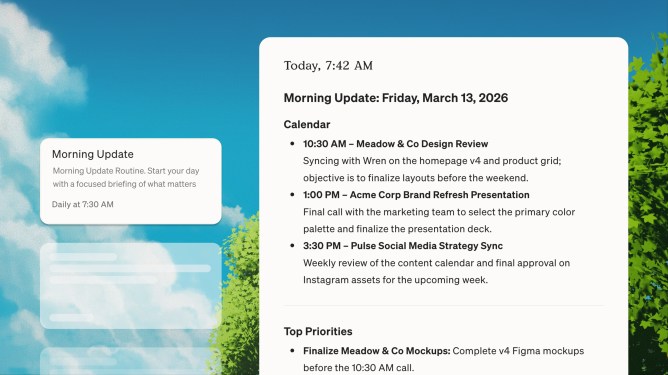
Another tool called Routines offers detailed prompts for Littlebird to run at a repeated interval, such as daily, weekly, or monthly. The company lists ready-to-use routines like daily briefing and weekly activity summary. Users can create their own routines with custom instructions.
Littlebird was founded by Alap Shah, Naman Shah, and Alexander Green in 2024. Brothers Alap and Naman founded Sentieo, a platform for institutional investors, which was sold to AlphaSense. They previously co-founded a healthy food company called Thistle. Alap was also a co-author of the viral Citrini paper on how AI agents could affect the economy. Green has built various companies in hardware, software, and AI.
The founders started the project by considering how AI is about user data, and that models do not know anything about you, which limits their utility. They were thinking about various interfaces and operating system paradigms ripe for disruption with AI.
Green noted that while Rewind was close to what Littlebird is trying to do, it relied on screenshots and did not have a great search experience. He said the startup is just getting started and there are many more problems to solve, including making large language models understand different kinds of context about users.
With Littlebird, users can remove their data at any time, and their data is stored in the cloud with encryption. Green said the rationale behind cloud storage was to run powerful models for different AI workflows, which is not possible locally. He stated they do not store any visual information, only text, which makes the data lighter-weight and less invasive than screenshot-based approaches.
Littlebird is free to download and use, but to get more usage limits and access to features like image generation, users can pay for plans starting from twenty dollars per month.
The startup has raised eleven million dollars in funding led by Lotus Studio, with participation from several individual investors. Several of these investors are regular users of the product. One investor noted the product removes the friction of remembering, retrieving, and re-explaining your own work. Another said he rewrote his company’s marketing site using the tool, pulling context from meetings, email, and other sources.
Another investor stated that AI is only as good as the context it has, and it often misses details about your day. He said for long-term success, the product will need to find a killer use case. The strategy is to release early features, see how people use them, and double down on those emerging use cases.