
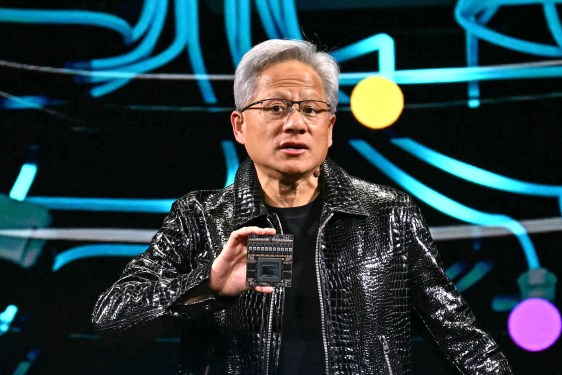
At the Morgan Stanley Technology, Media and Telecom conference in downtown San Francisco on Wednesday, Nvidia CEO Jensen Huang said his company’s recent investments in OpenAI and Anthropic are likely its last in both firms. He stated that once they go public as anticipated later this year, the opportunity to invest closes.
It could be that simple. While firms sometimes invest in companies right up until their public debut in search of more upside, Nvidia is minting money selling the chips that power both companies. It does not need to boost its returns by pouring even more money into either one.
Nvidia is not offering much elaboration. Asked for comment following Huang’s remarks, a spokesman pointed to a transcript from the company’s fourth-quarter earnings call. There, Huang said all of Nvidia’s investments are focused squarely on expanding and deepening its ecosystem reach, a goal its earlier stakes in both companies have arguably met.
Still, a few other dynamics might also explain the pullback. This includes the circular nature of these arrangements themselves, which have raised questions about a potential bubble.
When Nvidia first announced it would invest up to one hundred billion dollars in OpenAI last September, one MIT Sloan professor blandly described it as “kind of a wash,” observing that Nvidia invests in OpenAI stock, and OpenAI says it will buy an equivalent value of Nvidia chips.
That could explain why the commitment shrank. The investment Nvidia finalized just last week as part of OpenAI’s one hundred ten billion dollar round came in at thirty billion dollars, well short of that earlier pledge. If there is more to the story, Huang isn’t saying, having dismissed suggestions of bad blood between the two companies as nonsense.
Meanwhile, Nvidia’s relationship with Anthropic has looked fraught in its own right. Just two months after Nvidia announced a ten billion dollar investment in November, Anthropic CEO Dario Amodei took the stage at Davos and, without naming Nvidia directly, compared the act of U.S. chip companies selling high-performance AI processors to approved Chinese customers to selling nuclear weapons to North Korea.
In retrospect, a nuclear weapons comparison was the least of it. Just days before Huang appeared at the banking conference, the Trump administration blacklisted Anthropic, barring federal agencies and military contractors from using its tech after the company refused to allow its models to be used for autonomous weapons or mass domestic surveillance.
Within hours of that announcement, OpenAI struck its own deal with the Pentagon, a move Anthropic has called mendacious and the public appears to have viewed similarly. Within 24 hours, Claude shot to the top of Apple’s U.S. App Store, overtaking ChatGPT. At the end of January, Anthropic was outside the top 100.
Where that leaves Nvidia is holding stakes in two companies that, at this particular moment, are pulling in very different directions, and potentially dragging customers and partners along for the ride.
Whether Huang saw any of this coming, given Nvidia’s web of partnerships, is impossible to know. But his stated reason on Wednesday for likely pulling the plug on future investments, that the IPO window closes the door on this kind of deal, is hard to square with how late-stage private investing actually works. What’s looking more probable is that this is an exit from a situation that has gotten really complicated, really fast.