
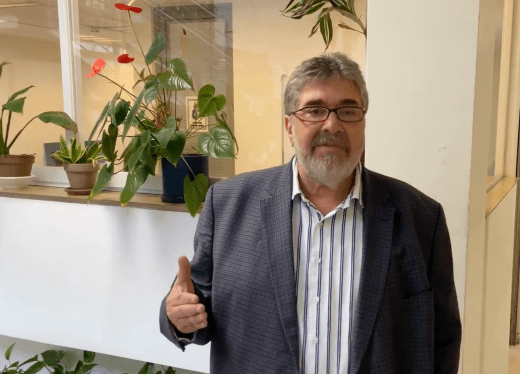
Years ago, when venture capitalist Jon Medved took an interest in backing various health tech startups, he had no idea that one day he would need them to improve his own quality of life. Israel’s tight-knit startup community received a blow in October when Medved, one of its most famous venture capitalists, announced he was retiring immediately. He was forced to step down from the firm he founded, OurCrowd, after being diagnosed with the debilitating disease Amyotrophic Lateral Sclerosis, also known as Lou Gehrig’s disease.
“This has come rather sudden,” he told TechCrunch in an audibly hoarse voice, a symptom of ALS, in what could be his last interview. “I had been feeling a little weird before and they didn’t know what was ailing me,” he explained. “I was in the hospital for several weeks recovering, and that’s when they tested me and said, ‘You’ve got ALS,’ which is a horrible disease, the worst you can imagine.”
ALS is a condition that degrades the brain’s motor neurons, leading to loss of muscle control and eventually impairing walking, talking, eating, and breathing. He said he didn’t have the classic symptoms, as his voice was attacked first, not his extremities. But he knows the condition will worsen, and there is no cure, only therapies.
Medved is considered one of the fathers of Israel’s startup ecosystem, often called “Startup Nation.” He helped usher it in, having moved from California to Israel in his 20s, then founding and selling several tech companies before turning to investing. In 2013, he founded OurCrowd. While Israel has many powerful home-grown venture capital firms, as well as branches of global firms, OurCrowd essentially invented crowdsourced venture capital, where a limited partnership was open to any accredited investor.
The firm’s roster attracted limited partners from Asia, Europe, the Middle East, and North America, growing a network of 240,000 accredited investor limited partners in 195 countries. Many of them are doctors, lawyers, and ordinary people who not only help their investment companies but would have otherwise been cut out of the wealth generation that venture capitalists experience. OurCrowd has backed names like Anthropic, Beyond Meat, and Lemonade.
Medved describes OurCrowd as now a “significant player,” backing about 500 portfolio companies with about 74 exits, including a recent exit when its infrastructure planning startup Locusview sold for $525 million.
Despite Israel’s conflict with Gaza, which has impacted its citizens, its startup ecosystem has remained strong. As the “startup nation,” Israel remains a key player for cybersecurity and defense tech, as well as AI, microchips, enterprise software, food tech, health tech, and more. For example, in November, there was $800 million invested in the Israeli venture ecosystem in one week, Medved said. The country now has nearly 100 unicorns, and he estimates that between $15 billion and $16 billion was invested in venture deals over the year.
Now the technology from some of these startups will help him navigate life with an incurable condition. For instance, he’s had an avatar made of himself that preserves his voice, face, and mannerisms. OurCrowd portfolio company D-ID, a maker of agents and avatars, partnered with voice AI startup ElevenLabs and other companies through the ALS-focused Scott-Morgan Foundation to create an avatar system designed for people with ALS.
He just experienced this technology during a Zoom call with another person who has ALS who was using an avatar to communicate. “So this stuff has become very, very personal to me,” Medved said. “It will preserve my voice when it goes.”
But he said there will be a variety of startup technologies he will lean on. “We’ve made 60, 70 healthcare investments in good companies that help people. We’ve got a company called OncoHost, which uses AI to help select what kind of immunotherapy will actually work for you. We have companies doing next-generation sequencing for the genome. We have companies doing chronic condition management,” he catalogs.
“I tell you now as a once-healthy person who took health for granted, I felt human pain and disease, but once you are actually engaged in one of these nasty diseases, it changes your perspective,” Medved shared.
All of this means that, even though he’s given up his position running the company and may be retiring from the public eye, “I’m far from over, ok? I want to continue to contribute, both to OurCrowd and the overall ecosystem. So I fully intend to not go off quietly into this good night.”
In the end, he says, “I’m very proud that in a small way, even though all we are is investors, to be part of this movement.” A video featuring Medved’s digital twin demonstrates just how realistic his avatar already is.