
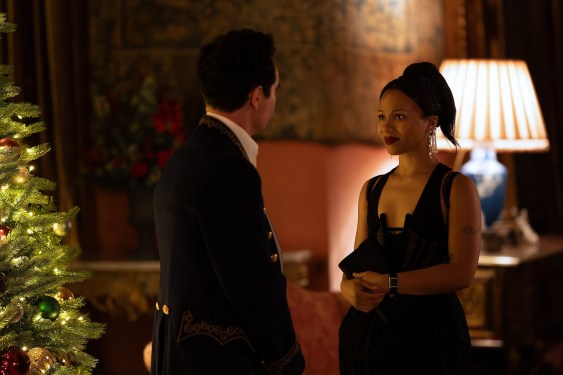
HBO’s hit financial thriller “Industry” has delivered one of its most compelling storylines yet this season with a hunt to expose a fraudulent fintech company called Tender. The show follows Harper Stern, who is leading her newly launched investment firm and looking for a company to short, essentially betting that its stock will crash. After a journalist tips her off that something is wrong with Tender, she sends her associates, Sweetpea and Kwabena, to Ghana to investigate.
What they discover is damning. Sweetpea tells Harper that fake users drive fake revenue which drives fake cash. The entire company appears to be built on fabricated numbers, leading to the conclusion that the thing is nothing.
This season of “Industry” speaks powerfully to the current moment. Tender begins as a payment processing platform for adult content. The show references the very real and still controversial Online Safety Bill introduced in the UK, which has led to age verification and other enhanced rules for consuming adult content online. Because of its affiliation with adult content, Tender finds itself at odds with the new government regulation and must pivot or die.
Its CFO-turned-leader, Whitney, wants the company to pivot into a bank and has a plan to make that happen, including making Tender’s CEO, Henry, the face of that transformation. Whitney embodies every tech baron cliche, moving fast and breaking things to win at all costs. He is lobbying politicians for a banking license and hunting for merger opportunities.
Harper, meanwhile, is leading her new firm after feeling undermined at her previous job and being called a DEI plant by the man who hired her, a nod to the decline of DEI in recent years. She has teamed up with new friends and old frenemies and is looking for a company on the precipice of crashing. To her, Tender is that company.
This puts her at odds with her friend Yasmin, who is married to Henry and is crafting communication and lobbying strategies for Tender. Their conflict provides the pride and prejudice that helps make the world go round.
The show nails the tech world with such accuracy that reality itself starts to feel like satire. Even TechCrunch gets name-checked as part of Tender’s media playbook. There is commentary on fascism via the character Moritz, who lobbies against Western liberalism and is hesitant to sell his family’s bank to Whitney, whose last name is the Jewish-sounding Halberstram. The character is perhaps a nod to the rising “technofascism” criticism of some tech barons.
Harper remains a calculating sociopath, stating that her real passion lies with finding dead men walking. She raises millions for her new firm. She is the one character whose existence strains credibility, as she must be shrewdly calculating with nothing to fall back on should she fail. This raises the question of whether the notoriously insular, exclusionary, and white UK establishment would really let a Black American woman rise through their ranks and beat them at their own game. As one Black British founder noted, who needs realism when she is such a great character. He said the show aptly captures how detached the UK upper class is from consequence and accurately portrays the ruthlessness of the British elite in maneuvering media and governments to suit their own whims. A European investor added that the depicted nepotism, lack of boundaries, and people sleeping together for trade secrets are unfortunately very realistic and common.
Meanwhile, Yasmin is headed down a dark path. Earlier this season, she organized a ménage à trois between her husband, Henry, and Whitney’s assistant, Hayley. As the season continues, her behavior becomes so hedonistic that one reviewer has already likened her to Ghislaine Maxwell, an emblem of what lies at the pits of money and power and the role some women play in digging those holes.
An Icarus moment could be on the way, however, at least for Whitney. The audience is familiar with how founders in the real world sometimes use deception to overinflate success and allegedly steal from investors and the public, with many such infamous cases referenced in the show. Perhaps the most relevant real-world parallel for Tender would be the ultimate implosion of the German fintech Wirecard a few years ago. Wirecard admitted that the billions in cash it reported having likely never existed, a tale of complex accounting and legal gray zones much like the fraud depicted in Tender. Short sellers went after Wirecard too, with one blog dubbing them alternative whistleblowers who step in when the market and the regulator refuse to see what is right in front of them. This is a philosophy one could easily see Harper embracing, especially after being told that short-only work is ugly, hard, investigative, and anti-status quo.
With Wirecard, numerous people, including the CEO, were arrested, while the COO went on the run and was also accused of being a Russian spy. Tender’s fate remains unrealized until the last few episodes run. One of the best parts about “Industry” is that it moves fast and breaks things. It is so clearly set in our time and so audacious in its demeanor that the audience is forced to pick their favorite anti-hero and go along for the ride. It is a rush and a thrill, the visual embodiment of the absence of ethical capitalists. And yet, just like in real life, we cannot get enough.