
CES has always been a robot extravaganza, and this year’s event saw the announcement of several important robotics developments. This included the new production-ready debut of Atlas, the humanoid from Boston Dynamics. The showroom floor was also filled with robots, which often serve as good marketing for the companies involved. While they may not always give a totally accurate representation of current commercial deployment, they do offer visitors a peek at where it might be headed. And, of course, they are fun to look at. I spent a decent amount of time perusing the bots on display this week. Here are some of the most memorable ones I encountered.
The ping pong player arrived at an appropriate time, just a month after the movie Marty Supreme came out. The Chinese robotics firm Sharpa had rigged up a full-bodied bot to play competitive table tennis against a staff member. When I stopped by their booth, the robot was losing to its human competitor, 5-9, and I would not characterize the game as particularly fast-paced. Still, the spectacle of a robot playing ping pong was impressive on its own. I’m sure I have known some humans whose paddle skills were equivalent to or worse than the bot’s. A Sharpa representative told me the company’s main product is its robotic hand, and the full-bodied bot debuted at CES to demonstrate that hand’s dexterity.
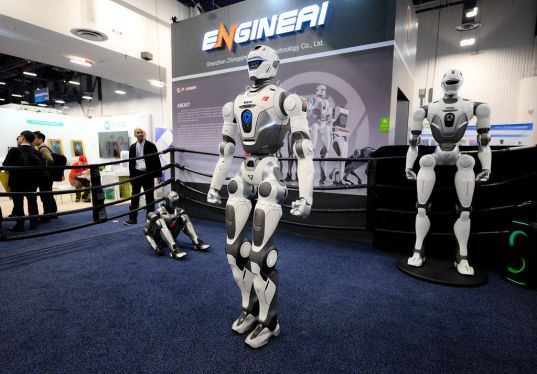
One exhibit that drew large crowds featured robots from the Chinese company EngineAI, which is developing humanoids. The bots, dubbed the T800 as a nod to the Terminator franchise, were in a mock boxing ring and styled as fighting machines. That said, I never saw them actually hit each other. Instead, they would sort of shadowbox near one another, never making contact. They were also a little unpredictable. One kept walking out of the ring and into the audience, which naturally got a rise from onlookers. At another point, one of the bots tripped over its own feet and face-planted on the floor, where it lay for a while before deciding to get up again. So, not exactly a Mike Tyson situation, but the machines still managed to evoke a spooky kind of humanoid behavior that made for high-quality entertainment. I overheard an observer quip, “That’s too much like Robocop.”
Dancing robots have long been a staple at CES, and this year was no different. This year, the dance-move torch was carried by bots from Unitree, a major Chinese robotics manufacturer that has been scrutinized for potential ties to the Chinese military. Unitree has made several impressive announcements about its product base, including a humanoid bot that can supposedly run at speeds of up to 11 mph. I didn’t see any evidence of anything nefarious at Unitree’s booth this week—just a lot of bots that were feeling the groove.
I stopped by the booth for Galbot, another Chinese company that says it is focused on multi-modal large language models and general purpose robotics. Galbot’s booth was styled to look like a convenience store, and its bot appeared to be synched with a menu app. A customer would come to the booth, select an item from the menu, and then the bot would go and fetch the selected merchandise. After I chose Sour Patch Kids, the bot dutifully retrieved a box off the shelf for me. According to the company’s website, the robot has been deployed in several real-world settings, including as an assistant at Chinese pharmacies.
Creating a machine that can fold laundry has long been one of the core ambitions of the commercial robotics community. The ability to pick up a T-shirt and fold it is considered a fundamental test of automated competence. For that reason, I was fairly impressed by the display at Dyna Robotics, a firm that develops advanced manipulation models for automated tasks. There, a pair of robotic arms could be seen efficiently folding laundry and placing it in a pile. A Dyna representative told me the firm had already established partnerships with a number of hotels, gyms, and factories. One of those businesses is Monster Laundry, based in Sacramento, California. Monster integrated Dyna’s shirt-folding robot into its operations late last year and now describes itself as the first laundry center in North America to debut a state-of-the-art robotic folding system from Dyna. Dyna also has impressive backing. It concluded a 120 million dollar Series A fundraising round in September that included funding from Nvidia’s NVentures, as well as from Amazon, LG, Salesforce, and Samsung.
I also stopped by LG’s section of CES to take a look at its new home robot, CLOid. It was cute but was not the fastest bot on the block. You can read my full review of that experience elsewhere.