
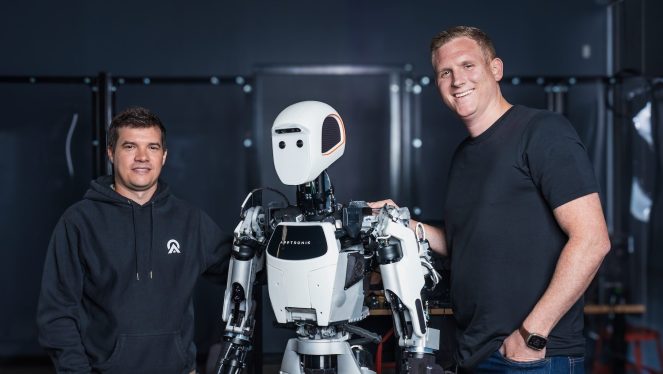
Apptronik, a University of Texas spinout that builds humanoid robots for clients including Google DeepMind, announced it has re-opened its Series A funding round. The company has now raised a total of $935 million for this round. While Apptronik did not disclose its valuation, sources indicate its post-money valuation is approximately $5.3 billion.
The company initially announced a $350 million Series A round one year ago. Due to strong investor demand, it first expanded that round to $415 million. It has now added another $520 million. This latest infusion comes from earlier investors Google, Mercedes-Benz, and B Capital, alongside several new investors.
Although it might seem the startup is simply selling more equity at its original Series A price, that is not the case. The company states its investors paid progressively more for shares in each subsequent extension. This values the company at roughly triple its initial Series A valuation of around $1.75 billion.
One might ask why this is not called a Series B round. According to a source close to the company, Apptronik considers itself still in early development stages and was not actively seeking funding. Instead, it was responding to significant inbound investor interest. An additional $520 million in a year, especially at a higher valuation, is difficult to refuse, particularly for technology as costly to develop as bipedal robots. For context, closely watched competitor Figure AI had raised nearly $2 billion since its 2022 founding before announcing a further $1 billion round last fall.
Part of the excitement surrounding Apptronik stems from its partnerships. The company has partnered with Google DeepMind, as well as GXO and Mercedes-Benz, to deliver what the industry terms embodied AI. This refers to robots capable of perceiving their environment and taking physical action based on reasoning, rather than merely following fixed instructions. The company states its robots are being built for tasks such as unloading trailers, picking warehouse inventory, and tending machinery.
Despite retaining an early-stage funding label, Apptronik is not new to this field. Its humanoid robotics work dates back to 2013, three years before the company was formally founded. At that time, members of the Human Centered Robotics Lab from the University of Texas at Austin competed in the NASA-DARPA Robotics Challenge, working on a robot called Valkyrie. NASA has maintained a partnership with Apptronik since then as the company developed its own humanoid robot, named Apollo.