
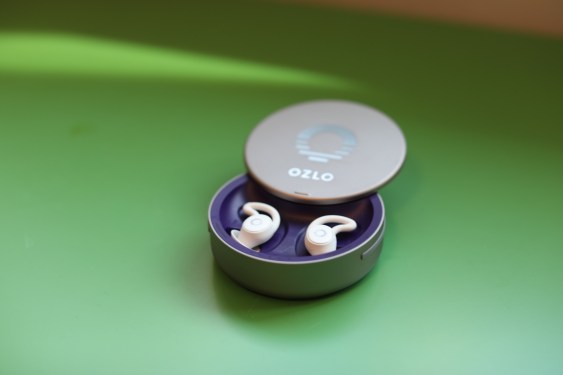
Ozlo, the maker of comfortable and easy-to-use sleepbuds designed to drown out outside noise for better rest, is evolving its product into a platform. The company’s plan began to take shape last month with a partnership announcement with the meditation app Calm. This effort accelerated at the Consumer Electronics Show in Las Vegas this week, where the company met with prospective partners to expand its reach.
These new partnerships could help Ozlo tap into new audiences and build a revenue model that extends beyond consumer hardware and into the profitable realms of software subscriptions and healthcare. For example, software features that use artificial intelligence or are designed to provide relief for users with tinnitus could be offered as premium subscriptions. A recent acquisition of a neurotech startup is also expected to help Ozlo expand from the consumer market into the medical device field.
Ozlo was founded by former Bose employees and always intended to build an ecosystem, according to co-founder and CEO NB Patil. The company built its first-party app on a software development kit for iOS and Android, meaning the features in its own app can be made available to any partner. For instance, Calm is using this kit to understand if its sleep and meditation content is actually resonating with customers. While Calm cannot tell from its app if a user has fallen asleep, Ozlo’s sensors can. The device detects changes in body movement and respiration rates, and a machine learning algorithm in the charging case determines sleep or relaxation states.
The smart case includes additional sensors for temperature and light, gathering more data. This information can be shared with partner apps. If a user begins a breathing exercise, Ozlo can detect if their respiration rate decreases and share that feedback. If the exercise is unsuccessful, the partner knows to adjust the content.
This partnership model creates a closed-loop feedback system, helping content creators understand what is effective. It also opens another potential revenue stream for Ozlo, such as taking a portion of a transaction if a customer upgrades a partner subscription. The company is in discussions with other sleep and meditation apps, and notes this system could work with various content types, including therapy or audiobooks.
Ozlo is also developing tinnitus therapy tools to address the ear-ringing condition that affects an estimated fifteen percent of its customer base. After partnering with Walter Reed Hospital for a clinical study, the company found that playing the correct masking frequency overnight for several weeks can help stop the brain’s irritating signals. These tinnitus therapies will be available via subscription, launching in the second quarter of 2026.
The company is expanding the insights it provides to its own customers through artificial intelligence. It launched a feature called Sleep Patterns in its app last November to help users understand their sleep duration, quality, and potential disturbances. This year, Ozlo plans to introduce an AI agent that customers can text with, acting as a sleep buddy. By integrating with other wearables and Apple’s HealthKit, Ozlo aims to better understand user patterns and needs. It also intends to connect with smart home devices, like thermostats, to set an ideal sleeping temperature automatically. These AI features are expected in the second quarter.
New hardware is also on the way. Ozlo’s next-generation charging case will address issues with the earbuds not seating properly in the charger. It will feature a redesigned antenna and extender for improved range, plus an amplifier to increase volume for masking loud noises like planes and trains. This updated hardware is scheduled for release in the second quarter.
Additionally, Ozlo will launch a bedside speaker in the second quarter. This speaker will offer similar functionality to the Sleepbuds but will not require an in-ear device. Equipped with its own sensor, it could track events like nighttime bathroom breaks or alert others if a fall is detected. This product allows Ozlo to market to families with young children, who are advised against wearing earbuds at night, and to elderly users who may prefer a simpler device. The company is also exploring adding a gentle wake-up light to a future product.
Acquisitions are part of Ozlo’s growth strategy. The Boston-based company recently acquired Segotia, an EEG-focused neurotech firm from Ireland. This acquisition will allow Ozlo to bring brain-level insights to its consumer device and develop tools for real-time sleep intervention. The technology involves custom eartips that measure electrical signals from the ear, which can derive brain activity data related to sleep and awareness. A product incorporating this EEG technology is planned for 2027, marking the company’s entry into the medical products field.
With a busy year ahead, Ozlo must execute well on each new feature and product to maintain its momentum and grow its customer base. The company will also require additional capital and is currently in the process of closing a Series B funding round, with more details expected soon.