
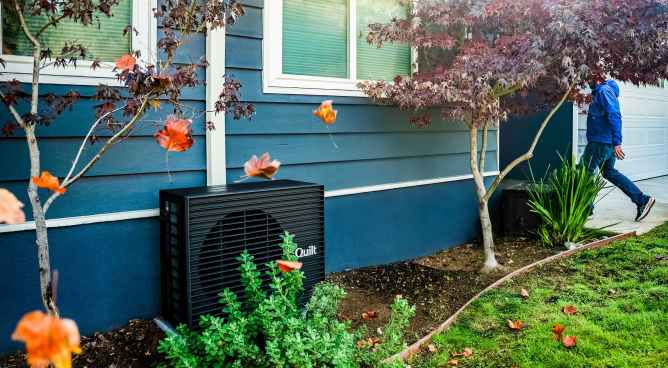
Smart home startup Quilt introduced a three-zone heat pump on Tuesday. This new unit promises to maintain high efficiency even in demanding conditions that often challenge traditional systems.
The three-zone unit functions exactly as described: a single outdoor unit can power three indoor heads, which is the term for indoor units in the HVAC industry. This design simplifies and reduces the cost of larger installations while minimizing the outdoor footprint. The product is central to Quilt’s expansion plans, which were recently accelerated by a $20 million Series B funding round focused on expanding sales.
The real story, however, is how Quilt developed this new product. Since its founding, the company has emphasized the extensive data collected from its internet-connected heat pumps, which are equipped with more sensors than typical models. By analyzing this data, Quilt engineers have achieved unique advancements. For example, in September they released an over-the-air update to existing heat pumps that unlocked an additional 20% capacity for one or two zones. This free update allowed homeowners to stay more comfortable during extreme heat waves and cold snaps.
The team also used this collected data to develop the new three-zone unit and solve a common challenge faced by competitors. Like all heat pumps, multi-zone systems perform best when running at variable speeds, meaning the compressor slows down when heating or cooling demand is low to deliver only what is needed. However, compressors become less stable and harder to control at very low speeds. Most systems compensate by stopping the compressor at a certain point, which sacrifices some efficiency and comfort.
Quilt was able to draw on real-world data from the roughly one thousand units already installed in homes and businesses. This provided insights into how systems operate across various climates and conditions, moving beyond limited lab testing. According to Matthew Knoll, co-founder and CTO at Quilt, this data allows them to optimize performance and address unusual scenarios that lab testing might miss.
The company also uses a larger copper coil than many competitors, enabling them to use a smaller compressor. This combination, along with other design tweaks, allows Quilt’s unit to deliver nearly 90% of its rated capacity at temperatures as low as -13 degrees Fahrenheit without sacrificing low-demand performance or efficiency. Quilt states this is the most efficient three-zone mini-split on the market.
To save power, each indoor head can be controlled individually, supplying very small amounts of heating or cooling as needed. Even when heating or cooling isn’t required, refrigerant continues to flow. Thanks to the outdoor unit’s advanced low-speed performance, it releases only about 300 BTUs of heat in heating mode, which is comparable to the body heat emitted by an adult.
Looking forward, Knoll did not comment on specific future plans but stated that Quilt wants to provide a solution for all homes. More products are in development, and it is likely that the company’s extensive data collection will continue to guide their evolution.